
Venice – Most Unique City in the World

I will do my best to describe the City of Venice and what’s it’s like, but I believe it is one place in the world you should experience yourself to truly understand and enjoy just how unique it really is. Cathryn and I have both been there before but we loved it enough to visit once again for her 60th birthday year. Our plan for this trip was to skip the heavily trafficked touristy sites and take in the outer islands of Torcino, Burano and Murano.

If we stay more than one night in any location I try to book something with a kitchen, such as an Airbnb or something on VRBO so my personal chef can prepare some of our meals in. This worked well for us since breakfasts in Italy consist of pastries and coffee, one of which is bad for my waistline and the other something I’ve never consumed. Lunches were usually some type of ham sandwich while we were out exploring.

Although my chef prepared some awesome pasta dinners in, we ate many of our dinners out. Pasta and pizza are available everywhere and usually the cheaper way to go. Seafood dinners were also easy to find but many were pricey for us since 1 Euro is equal to about $1.40 Canadian. Thankfully, food tax is virtually non-existent and tipping is not customary in Italy. But many restaurants charge a 2-3 Euro service fee to make up the difference.

Venice. Some call it the floating city but it’s actually built on reclaimed land in a lagoon, on thousands and thousands of wood pilings. It explains the lack of trees. Experts blamed those same foundations as the reason for Venice’s sinking but it’s now been discovered they’ve drained underground aquifers for centuries to get drinking water, causing the city to sink. Higher sea levels and advancing tides also invade the city, meaning Venice’s life expectancy is limited.

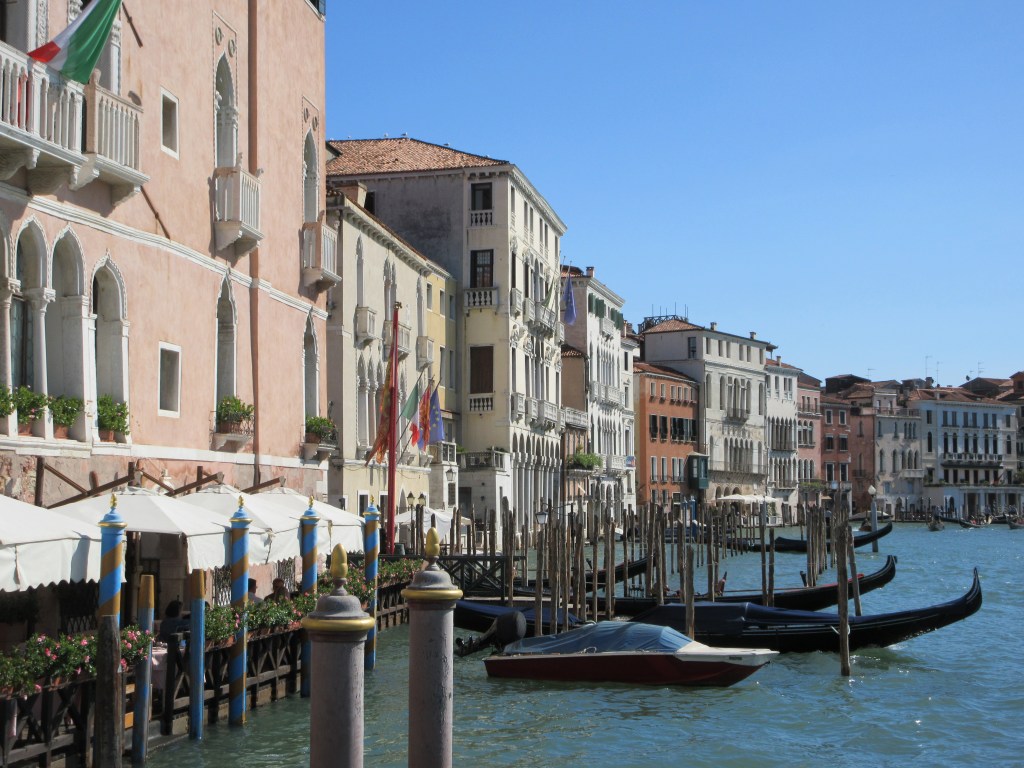
Venice. You won’t experience such a unique city anywhere else in the world. Once a place where people in the 5th century fled to avoid Barbarian conquerors, it later became a major trading hub for fish and salt and by the 9th century it had become a major maritime empire. Arriving in Venice by the Grand Canal, which snakes it’s way through the center of the city, you can still witness the magnificent palaces and buildings showcasing Venetian prosperity.

Nowadays, Venice makes it’s money from mass tourism. It’s gotten so bad that the city had forbidden large cruise ships and they charge a visitation/tourist tax. But it’s still a really cool place to visit, especially if you like history, ancient Byzantine and Baroque architecture, palaces, churches, canals, and Italian food.

Try to imagine a place where there are no front lawns, only water. No cars or trucks. You get everywhere by foot or boat. Even mass transportation is by waterbus, called vaporettos. Those with deep pockets can hire beautifully varnished watercraft, and some locals own their own boats to get around. Everything in Venice moves by water and the canals – people, food, and garbage.

The city is known for it’s gondolas, a hand-crafted canoe of sorts that has become a must-do thing for visiting tourists. The boats costs thousands of dollars to build and gondoliers go through a 4 year training course to master their trade. Some serenade their fares while rowing and weaving their way through various canals. Our apartment overlooked one canal and we watched wide-eyed tourists and even wedding parties go by. It was way better than the cars and trucks that roared by daily at our last place.

Our plan to visit the outer islands made for a perfect visit. We took the vaporetto to Torcello first, a little over an hour away but well worth the trip. Leaving at a popular time of day, our boat was quite packed until the last leg. The island is where it all began, where the Venetians started to build in the lagoon. The cathedral was built in the 7th century and is one of the oldest churches is Italy. Exploring the island left me puzzled, trying to figure out how 20,000 people once lived there. Now there are only 12.

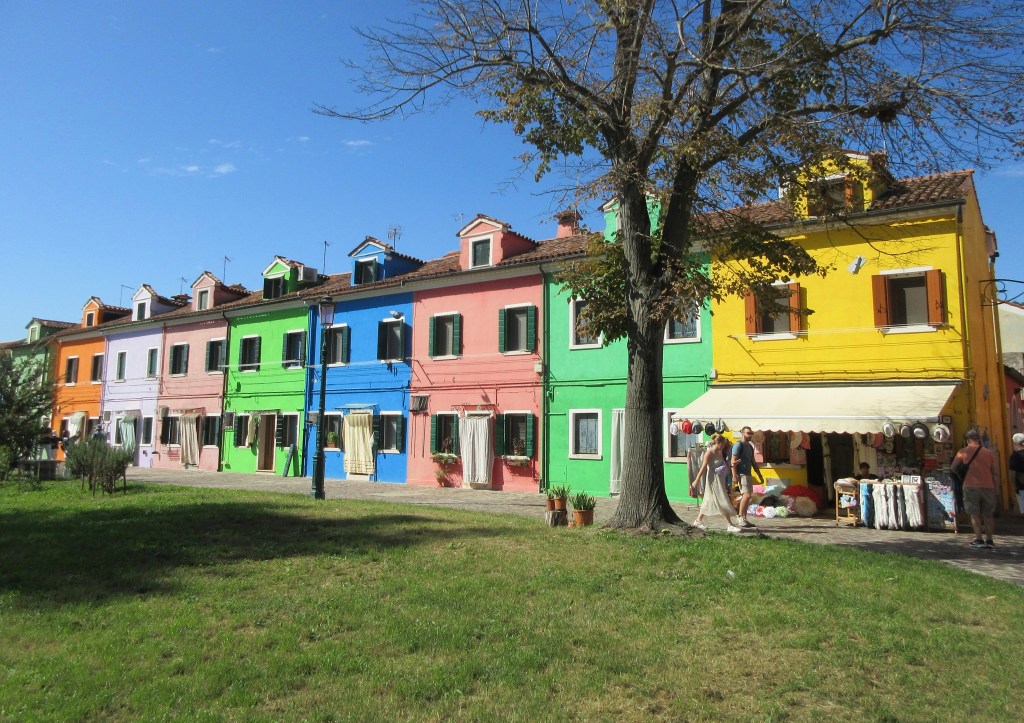
Burano was our next island stop and it completely blew us away. It is easily the most colourful place we’ve ever visited – houses, shops and buildings are all stuccoed or painted in various pastel colours, making neighborhoods look like rows of saltwater taffy. Like the main Venice island, Burano also has canals and plenty of pedestrian only streets to explore. For Cathryn and I, it is our favorite Venetian island.
We visited the island of Murano too but were hard-pressed to be wowed after seeing Burano. But if you’re into hand-crafted Venetian glassware, Murano is the place to go. There are several glass blowing factories to visit and hundreds of stores selling everything from fancy chandeliers to miniature glass ballerinas. The glassware is impressive but the canals and buildings are similar in size and construction to those scattered across the City of Venice.

I conclusion, having been to Venice myself on two previous occasions I wasn’t too excited to see it again. But just as it was on my very first visit, the city grows on you. The heavily-trafficked touristy sites are definitely worth seeing for the first time. But the back streets (like the Jewish Ghetto) take you back in time, where neighbours gathered in piazzas or courtyards. Children without electronic devices, boys playing football and girls skipping rope. Men gathered to drink coffee or beer and women working in the kitchen sending wonderful aromas out the window to passerby.

Mass Tourism – Us vs Them

Mass tourism has become a taxing and ugly thing for many countries, cities, and famous sites around the world. With the advent of the Internet, they say the world has become a smaller place. Add the ease of air travel and other modes of transportation along with human curiosity, and one can see why the masses have ventured out from their own backyards to seek out unique and fantastic places to visit.

Cathryn and I were ‘travellers’ long before we met each other. She was lucky enough to do several trips with her family. Mine was larger without the money for that kind of thing but my brother and I managed a trip to Florida with my mother and her boyfriend once we had a job and were able to pay our own way. After securing my career as a police officer, I used my pay cheque for a motorcycle trip back down to the sunshine state.

My wanderlust and thirst for travel continued with trips throughout Canada, the U.S., Europe, Mexico and the Caribbean Islands. I did one cruise because of the unique ports of call but didn’t like scheduled meals and events on board, as well as the process of trying to get hundreds of people on and off the ship every time it docked. We relied on travel agents and ‘packaged’ tours back then, with our absence from work limited by allotted vacation time.

Retirement rewarded me with unlimited time to travel. One or two-week vacations became a month or more, allowing me to venture further abroad for longer. Changing with age and the times, I went from backpacking around Europe to flashpacking (backpack on wheels) in Southeast Asia and South America. Solo motorcycle trips up, down, and across North America evolved into trips for two, with Cathryn joining me on the Harley.

I’d found my life partner, with similar tastes in music, food, travel and life itself. Once Cathryn retired, the world was ours to discover. And at that we’re doing our best. For us, seeing new places and experiencing different cuisine and culture is what life in is all about. Being financially secure, our only travel limitation seem to be there as so many places to visit and not enough time to see them all.

I have a travelling friend who emigrated from Canada to Cambodia, where he settled and started a family. As a fellow traveller, he often sought out places off the beaten path that hadn’t been discovered by the masses or had fallen victim to overtourism. Up until about twenty years ago, I hadn’t found crowds to be a problem in my travels to other countries around the world. For the most part, tourists seemed to be happy sticking with the tried and true destinations where everyone else had been or was going.

But the world truly has gotten smaller, with more people venturing further away from home, seeking out exotic places they’ve seen on television or on the Internet. Places that were once considered off the beaten path or undiscovered by the masses. Hoards of vacationers and travellers alike have taken to road, rail and air, in search of cool places they had only previously dreamed of.

Now that the masses have converged on those very places, destinations have become overcrowded and almost unbearable to travellers and locals alike. For us it means higher prices or limited availability for transportation and lodging. For them it means hoards of travellers invading their home towns and neighborhoods. Where tourism was once good for local economies, it is now taxing public services and infrastructure.

Cathryn and I witnessed such a mass invasion firsthand in Dubrovnik, Croatia, a once small fishing village made famous by the Game of Thrones tv series. We were enjoying a quiet stroll along the top of the city walls when we saw a cruise ship pull into the harbour. By the time we came down from the wall, the small medieval town had been invaded by five thousand tourists, all trying to find famous sites they’s seen on the tube.

People from the cruise ships pay good money for those types of excursions. I had to laugh when I saw hungry tourists scouring the old town trying to discover the magical places they saw on their favorite show. The group was disappointed when their tour guide explained how almost every backdrop they’d seen on tv was computer generated.

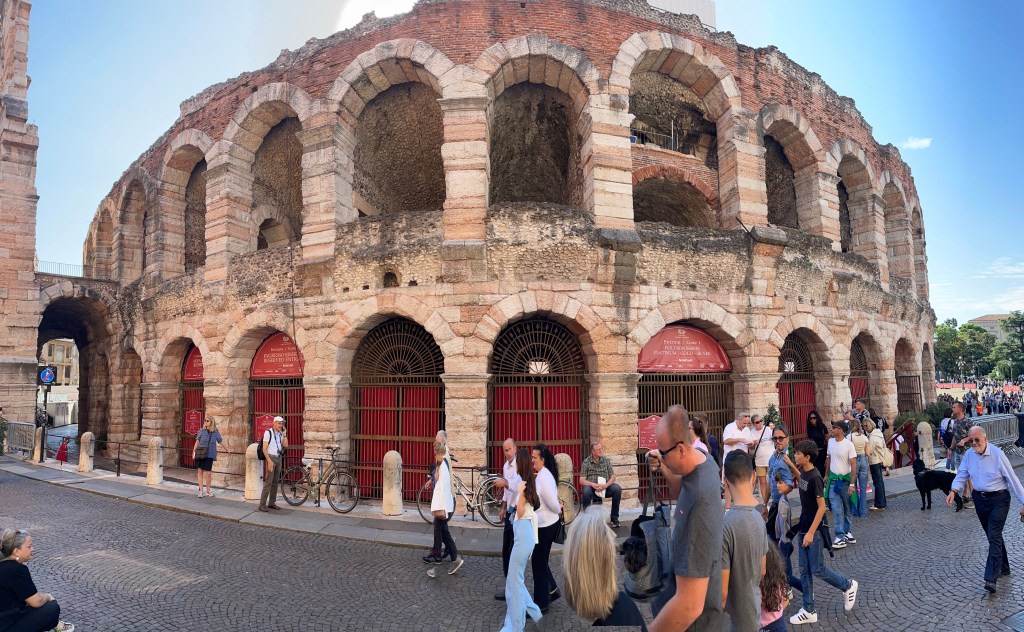
We are currently in Italy where crowds have varied from town to town. We chose the shoulder season – September and October, purposely to avoid the masses. But that wasn’t the case in Verona, where we’d considered seeing the famous ‘Juliette’ balcony. Although the character and story are fictional, it doesn’t stop thousands of tourists from reserving a spot online in advance to visit the site and have a chance at rubbing a breast on her statue for good luck.

We did not see the balcony or broze-breasted statue, but did manage a peak at the alley leading to it from our city tour bus, surrounded by thousands of tourists. What’s really funny, besides the love story being fictional, is that Shakespeare basically plagiarized the tale from other poets. It’s also never been proven he actually set foot in Verona, let alone Italy.

So, if you plan to travel, beware of mass tourism. Venice doesn’t allow cruise ships in the harbour anymore and charges by the day to enter the city. Locals have complained their neighborhoods are now full of foreigners staying in rentals. Santorini, Greece becomes gridlocked when several thousand cruise ship tourists try to cram into the tiny fishing village to get that perfect selfie.

Barcelona and Malaga, Spain, are now passing bylaws to limit the number of vacation rentals in heavily travelled tourist destinations. Perhaps this comes as a result of post Covid travellers trying to make up for lost time, but I think not. It seems to me more and more people in the world now have itchy feet and have discovered their dreams and wanderlust can become reality.

Favorites – Venice

img_1194

I can’t count how many times I’ve been asked where’s my favorite place I’ve visited. And, for those of you who know me personally, I don’t really do favorites. So why, you ask, am I posting Venice as one of my favorite places? Well, I must shyly admit that it is. Right now it’s the number one tourist destination in the world. That’s big.

Continue reading “Favorites – Venice”