Cathryn and I left Melaque, Jalisco, Mexico last year in search of a new winter home where it’s sunny and warm every day. We have lots of good memories from the Costalegre but it was time to move on. Our journey took us up the Pacific coast through Puerto Vallarta to Mazatlan. From there we drove another four hours north and took a ferry across to La Paz, on the Baja peninsula.
Looking for our next winter home, we explored Baja California Sur (south), spending three days in each of the towns, San Jose Del Cabo (where we visited Todo Santos), La Paz and Loreto. We really liked La Paz but found it a bit too big, busy and more expensive than we liked. We only spent a short time in Loreto but liked the vibe and decided it would be our next winter nest.
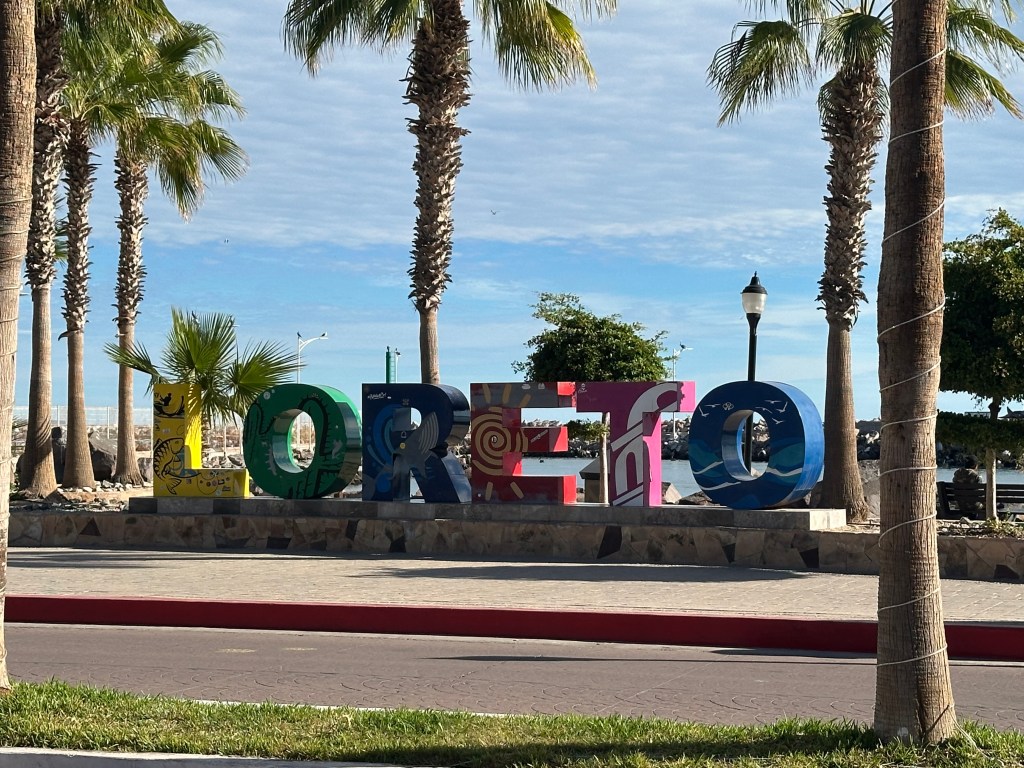
Fast-forward to January this year and we’ve now been in Loreto for about ten days. We like small town Mexico and with about 20,000 inhabitants plus some expats and seasonal tourists, Loreto fits the bill. It’s a very walkable town with no giant resorts, brand name restaurants or fast food chains. The town sits on the Sea of Cortez/Gulf of California, which includes a national marine park with whales, sea lions, dolphins and world class sport fishing.
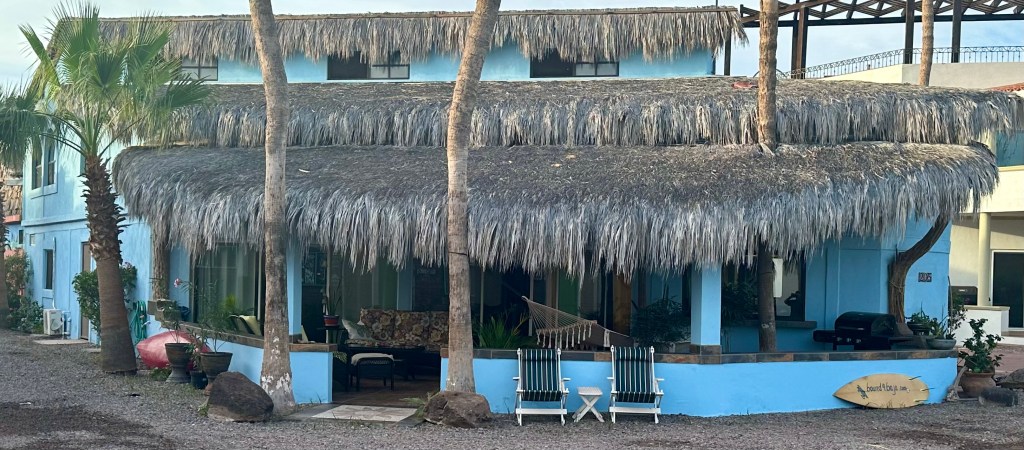
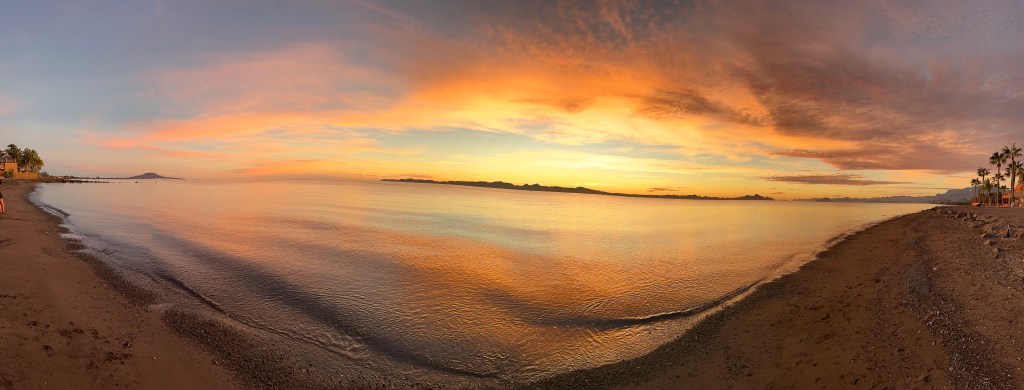
We opted for an Airbnb for three months. The beautiful 3 bedroom casa offers a sea view and is only a stone’s throw from the beach. The sun shines every day, with temperatures between 60 and 77 degrees fahrenheit – a tad warmer than or weather back home right now. We had a few drops of rain one day but not enough to wet the ground. The Baja is mostly desert so there is no humidity here (yeah).
It’s always a challenge settling in to a new town, when it comes to buying groceries or dining out. There are no Costcos or Walmarts here but my personal shopper has managed to bring home the goods and we’re not going hungry by any means. We’ve also found great seafood at a nearby restaurant and scored the best burrito ever, last night at a little hole-in-the wall place where they cook on a mesquite grill right in the restaurant. The super burrito was the size of my forearm.
Many have described Loreto as a hidden gem, a Mexican location that will no doubt keep growing inpopularity among tourists and snowbirds. Giant cruise ships have recently discovered the town and come in about once a week during high season. But for the most part, we’ve found Loreto to be a pretty sleepy town with no reservations required or lineups to get in anywhere.
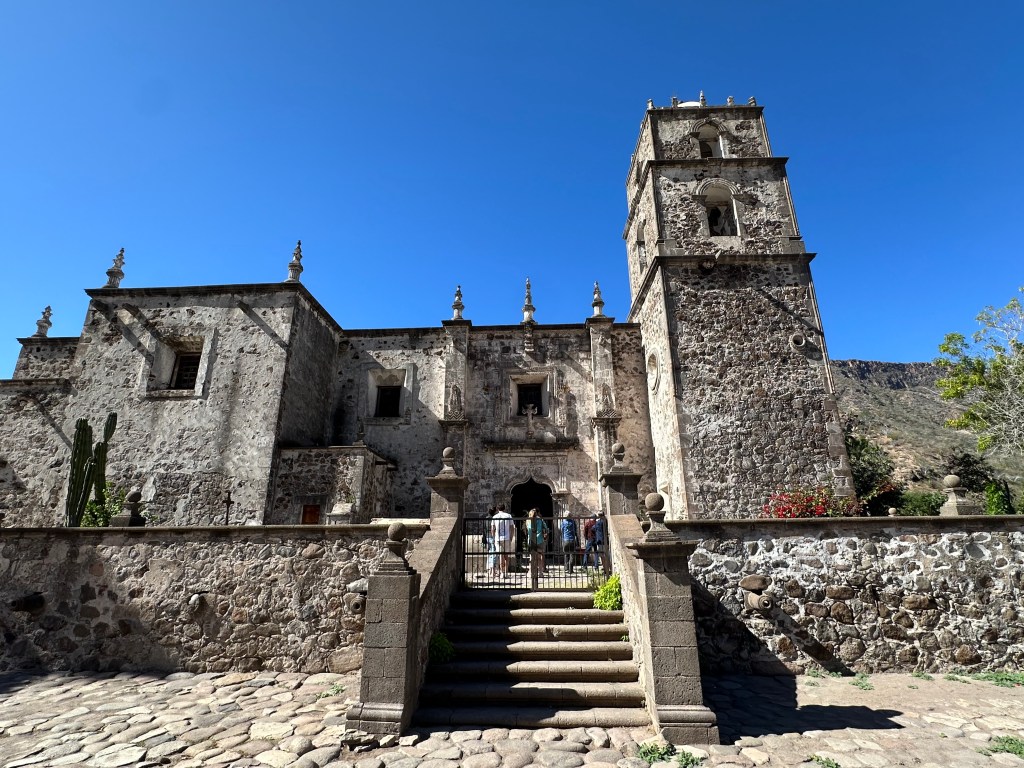
The people are friendly and take pride in keeping their town clean – unlike many other places in Mexico. There is plenty of culture, with many historical landmarks that include 300 year old Spanish missions. There are miles of beach that are walkable and easy to access. Prices on everything from accomodation, to food and booze are about 30 percent cheaper than home.
The jury is still out on whether or not we will return to Loreto next year, but so far we are thoroughly enjoying our time here.
After spending several years in Melaque, Mexico, Cathryn and I decided to find a new winter home for next year. We enjoyed our time in Melaque and met new lifelong friends there, but for various reasons we wanted to move on. One being, there are so many other beautiful places in the world we want to see.
Normally, we stay put for three winter months but we left Melaque on March 1st. With every available space in the Chevy Malibu completely packed, we headed north up the Pacific coast of Mexico. With the area around Puerto Vallarta previously explored, we ventured further north to Guayabitos, staying across the Puente de Vida, in Rincon.
We’d been there before and returned to a beach restaurant called Juan’s, for the best shrimp nachos in Mexico. The next stop was Mazatlán, where we spent two nights. We’d been there before too but this time we found ourselves in the middle of Carnivale, one of the largest week-long celebrations in Mexico. Not being much of a parade person, I found the gargantuan floats amazing.
To cross the Sea of Cortez we ventured further north to Topolobampo, where the ferry makes the crossing in about six hours instead of twelve from Mazatlán. Regardless, the sea journey is overnight so we booked a cabin instead of sitting in row seating with a hundred other stirring or snoring passengers.
The sea crossing was uneventful but I could write another whole story on stupid ship rules and how it messed up our arrival in La Paz, Baja California Sur (southern half of Baja) The main problem is they don’t let passengers stay in the vehicle while embarking or disembarking. Cathryn and I were left to fend for ourselves and find each other on and off a ship carrying over a hundred vehicles and probably twice as many people, all speaking Spanish.
I drove in circles while she wandered aimlessly, being directed and misdirected trying to reconnect in La Paz. Other little surprises not included in the ticket were weighing and paying for my car to board the ship, port charges upon disembarkation, and even another thirty pesos for some dude with a garden sprayer to ‘disinfect’ my car before entering a different state in the same country.
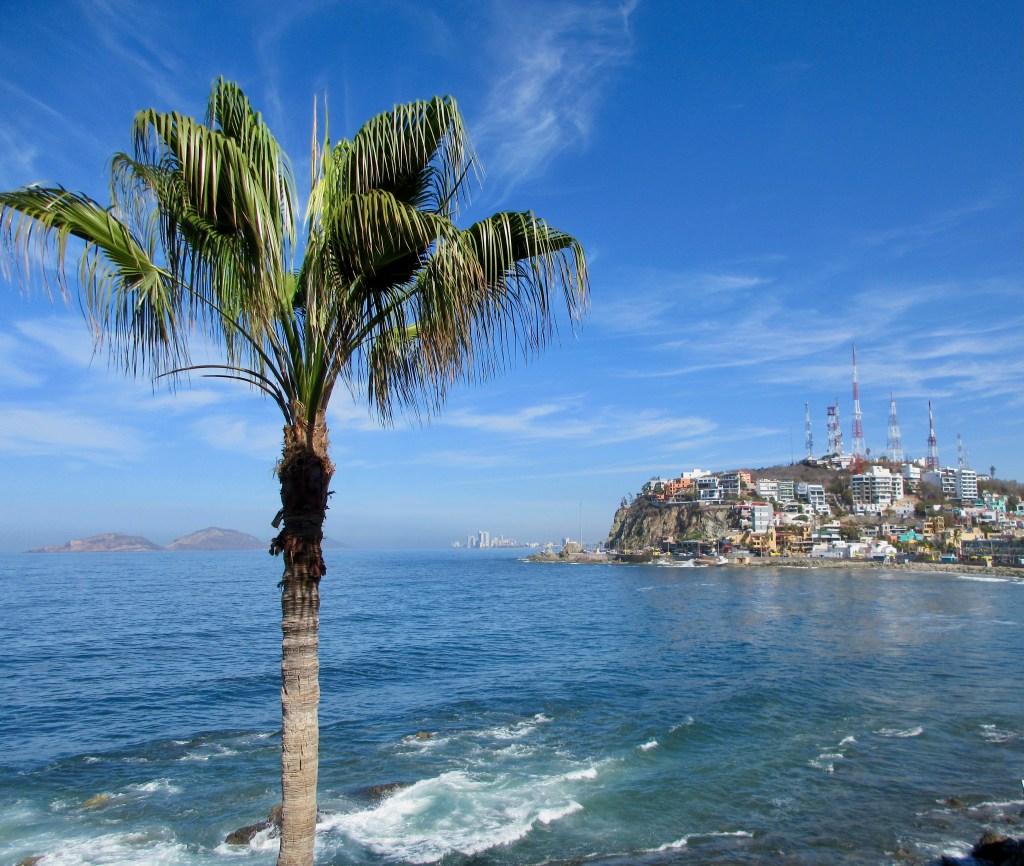
Breathing in fresh sea air and basking in the morning sunlight of La Paz made it all worthwhile. Heading north, the Sea of Cortez took on shades of azure and blue I hadn’t seen since Thailand. We were too early for check-in at our Airbnb so we explored the neighborhood we’d be staying in and found an awesome spot breakfast spot for some very creative and tasty eggs bennies.
La Paz was impressive, with the sea and little beaches on one side of the waterfront drive, and shops and eateries on the other. The Malecon runs the entire length of the city, with wide sidewalks and open pedestrian areas or parks, and a bike path running between it and the road. Everything was easily and safely walkable, unlike some of the crazy paths and roads in Melaque.
We stayed in La Paz for three nights, enjoying some of the best food we’ve ever had in Mexico – seafood, meats, and even sushi. The city quickly became our top contender for our next winter home. But there were other places to explore and we moved to San Jose Del Cabo for the next three nights. Driving into the city, I found it a lot bigger and busier than I’d hoped for. But our Airbnb was in a quiet neighborhood away from the traffic noise.
We were close to the historic old part of town, our destination for the first morning walk. We were greeted with cobbled streets and colorful Spanish architecture, leaving us slack-jawed more than once. The streets are lined with little artisan shops and eateries – one bar serving up a burger that was second to none. It’s price was similar to home but we got ripped for $22 Canadian for a margarita.
San Jose has basically become a suburb of Cabo San Lucas, where pricy restaurants and mega resorts have become the norm, taking over almost all public oceanfront space. We found it very difficult to find a nice beach that wasn’t accessed through a private hotel road or property. Knowing and seeing what we did, there was no reason to venture further south into Cabo. It didn’t make our list.
Instead, we drove west and spent a day in Todo Santos, an ‘artisan’ town, about thirty minutes from the two Cabos’, on the Pacific side of the peninsula. We explored the streets and shops and found some great restaurants. It was the perfect town to wander, shop, eat, and snap photos. Unfortunately, the town itself is landlocked and we had to drive some dirt roads to find the beach.
It was an adventure finding the ocean but worth the drive once we saw the offering. Miles of empty beach and blue water as far as we could see, in either direction. We only saw four other people…two on the beach and two coming as we were leaving. Todo Santos was a great place to visit but it didn’t make our list either.
The drive north from San Jose proved just how beautiful the Baja desert could be, it’s every-changing varieties of cactus, winding roads through rolling hills or mountains, and glimpses of the bluest water we’ve ever seen. Sometimes there was nothing for a hundred miles, including rest stops or gas stations. Then we’d come across a desert oasis, with lush greenery and a waterfall. Or a restaurant/flea market that was an old woman’s home, in the middle of nowhere. With good breakfast burritos.
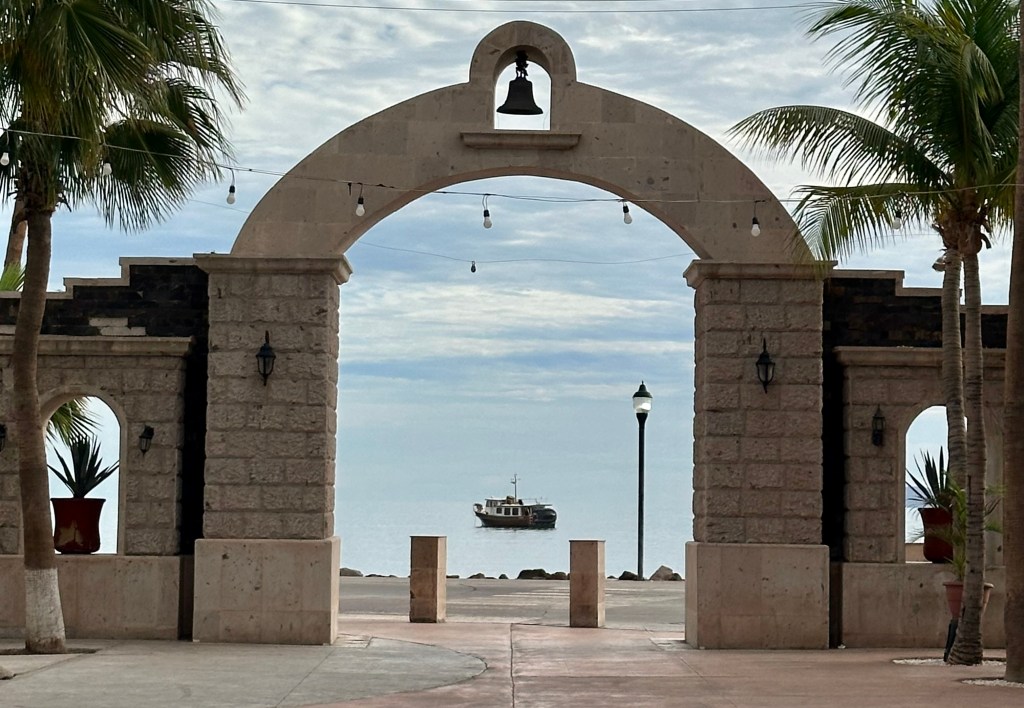
Navy, cobalt and azure shades of blue in the Sea of Cortez lured us into Loreto Bay and the encompassing town. It’s home to the Loreto National Marine Park, habitat for a variety of whales, sea lions, dolphins and the blue-footed booby (no kidding, look them up). At first glance, Loreto looked like any other small Mexican town.
The view from our oceanfront Airbnb changed our perspective on things. Our first night’s dinner at a nearby seafood restaurant really got our attention. The next morning’s walk along the Malecon and beach was impressive. A stroll down the pedestrian street leading to ‘Centro’, the town’s historic core, was interesting. Our breakfast in a little bistro in the main square was about the time we started to fall in love with Loreto.
It’s what they call a Pueblo Magico, a magical Mexican village that offers cultural richness, historical relevance, local crafts, great hospitality, and our favorite part – cuisine. These designated places also offer a variety of things to see and do. It’s also one of the cleanest Mexican cities we’ve visited. Loreto had a great vibe and quickly moved to the top of our list.
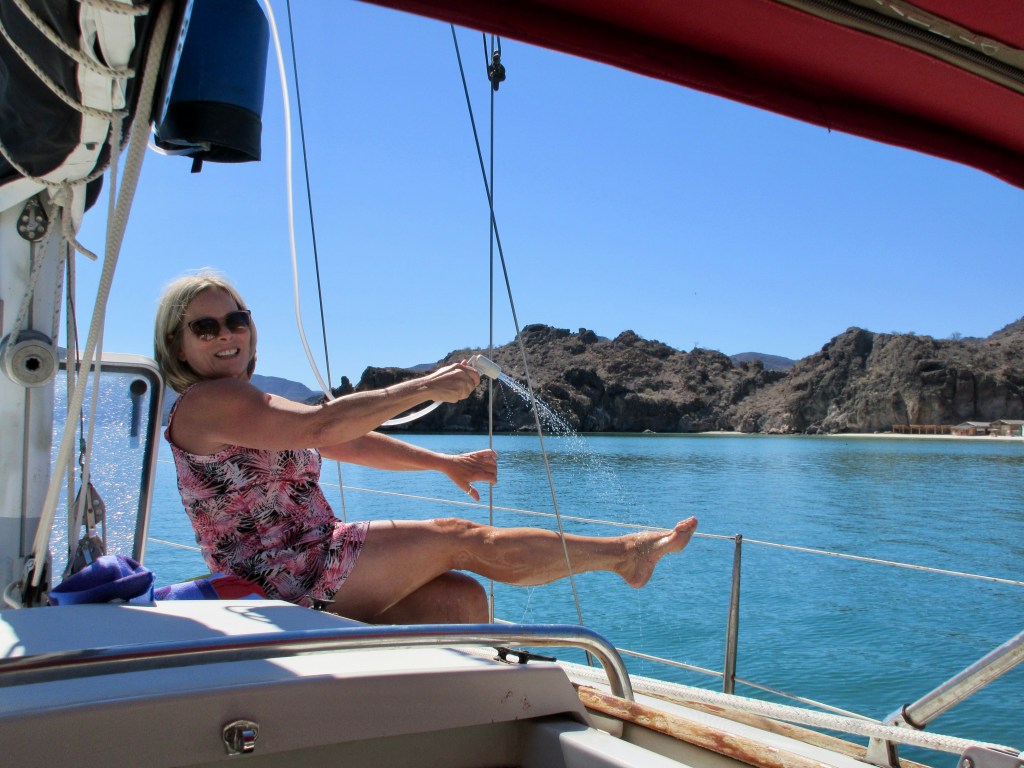
From Loreto, we continued north along the Sea of Cortez to the Bay of Conception (near Mulege), where we spent two nights of a sailboat. Click here. See that story for our adventure. We also explored various beaches in the area and learned not to judge a book by its cover when we ate lunch at a roadside taco stand near our floating hotel.
The drive north from Loreto and Mulege offered great desert scenery but terrible pot-holed roads. It was next to impossible to enjoy the landscape while dodging the deep holes, some that could easily swallow half a car’s wheel. The road off the highway leading to our next destination only got worse, forcing me to stop in order to find a path that would cause the least damage.
The town of Bahia de Los Angeles is huge for sport fishing. Our hotel was up the coast a bit, where our ocean view room offered a front row seat to pods of dolphins swimming by. We could never tire of staring at the blue Sea of Cortez. Cathryn added the beach to her list of favorites for shell collecting – the bag in the trunk of our car was growing exponentially.
The drive north and west through more Baja mountains took us to the city of Ensenada, where we stayed a block away from the Pacific coast in the historical ‘Centro’ district, chock full of trendy restaurants and boutiques. We also enjoyed a nighttime stroll along the seafront boardwalk were cruise ships from California visit.
Ensenada was the last Mexican city on our Baja adventure. From there we crossed a small border east of Tijuana but unfortunately our GPS took us into the city. An hour of driving in circles, outrageous border traffic and an anti-Trump demonstration, cost me a $150 bribe to the local police who stopped me for a one way street violation when I tried to avoid the traffic jam. It was either have my car towed or buy them dinner.
Driving along and seeing the huge steel border wall at the U.S. border was surreal. We were worried about all the political nonsense going on north of the border but we were welcomed into America and waved through customs without question. We made our decision while in Loreto and booked a place there to return to next winter.
First of all, don’t get the idea that Cathryn and I are sailors or had any intention of sailing any type of boat anywhere. What we chose to do, instead, was spend two nights at an Airbnb, so to speak, on a tethered 28′ sailboat in Bahia Concepcion in the Sea of Cortez, off the peninsula’s east coast.
Having watched a travel video of another couple who spent time on the floating Airbnb, we thought it sounded like a cool idea that we had to try. As in past winters, we’d spent time in Melaque, Mexico. But on this trip we decided to cross the Sea of Cortez and see Baja California on the drive home.
After spending time on land in La Paz and Loreto, we headed towards Mulege and our host’s beachfront shack on Playa El Burro in the Bay of Conception. It’s the home of ‘Delirio’, our Waterbnb. Silvia, our host, was standing out front and waved us into our personal parking spot beside her beach house, not 30′ from the sea.
Our floating hotel could be seen about 500 yards offshore but we were first introduced to our ‘Uber’, the small rubber dingy that would be our transportation to and from the boat. Our host detailed the whole nautical experience to us and made quick work of explaining how I would be driving our own Uber.
Thinking ahead how to pack for this unique experience, Cathryn and I loaded our one bag of clothes and our cooler into our water shuttle. With my vast experience in operating a small vessel and outboard motor, I fired up Uber with only three yanks on the pull cord. Delirio beckoned to us but wind and choppy water made the half kilometer trek seem like five miles.
I failed my first attempt at docking portside along our bouncing hotel and had to loop around for a second attempt. Having probably done so a hundred times before with other land-lover guests, Silvia casually laughed and told me to have at it again. With my limited lower body flexibility, climbing aboard a moving target from a moving dingy proved to be another challenge.
My nimble and flexible wife hopped on like Gilligan boarding the S.S. Minnow. Once on board, Silvia gave us the grand tour of our accommodations. We nodded along, pretending to understand but knowing we’d forget half of what was said right after she left. I laughed out loud when our host pointed out the head and showed us how to use it. I knew my next challenge would be figuring out how to fit into the tiny room.
The Bathroom
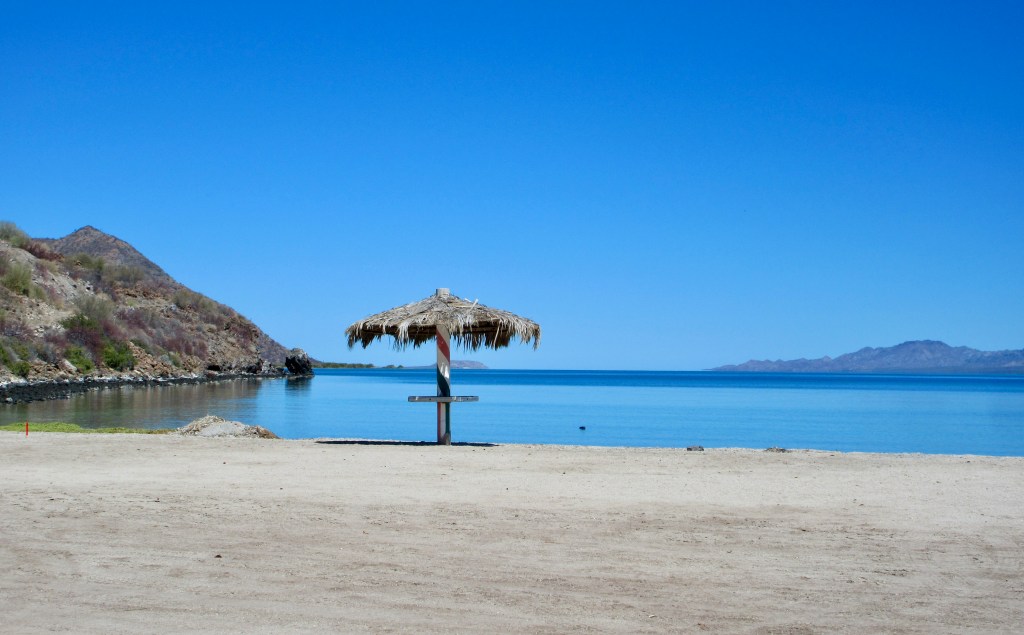
Getting off the boat proved easier than boarding. We had to take Silvia back to shore and then return on our own. Experiencing the rough sea once again, we decided to stay on land wait for smoother sailing, giving us a chance to explore our beach and El Burro bay. It’s about a one kilometer stretch of sand and pebbles, lined with a variety of beach shacks.
Calmer water and my excellent seamanship made it a piece of cake returning to the Delirio. She was still weaving and bobbing a bit so we decided some Gravol was in order, just to be safe. My first trip to the head was a life-changing experience. Just pee overboard, you might say. Have you ever tried that with your manhood in one hand and holding a rail with the other to avoid falling overboard?
It was a good thing Cathryn didn’t have to go, she nearly pissed herself laughing at me trying to wedge my 6′-1″, 240 pound body into a bathroom about the size of a microwave oven. I managed to get in but couldn’t stand up straight. Then I remembered the hatch above – Silvia said she could tell when men were peeing because she could see their heads sticking above deck. Whatever works. Nice view.
Having had such a rough day so far we decided to lay back and relax on deck, gently bobbing up and down with the waves, admiring the difference in shades of blue between the sky and sea, and laughing at the pelicans crashing into the water for their next meal. Truly enjoying the serenity surrounding us, along with the gentle breeze and warmth of the Baja sun, we both dozed off.
Waking up hungry, Cathryn and I weighed our options. Looking at the still rough water and our bouncing uber, the decision was easy. We dug into our food supply and made fried egg sandwiches. Watching the sun set and day become night was surreal. There was a slight chill in the air but we stayed on deck and wrapped ourselves in Silvia’s wool blankets.
A Stingray cruised by portside, nearly sideswiping Uber. Stars appeared one by one, like kernels of popcorn in a hot pan. Cathryn broke the silence asking, “What the hell is that?” I laughed. An orange beacon appeared over the mountains across the bay. It was the moon and I told her so. “No”, she said, “It doesn’t look like that at home – it should be way up there…and white.”
I laughed again. The moon was full, fully recovered from the previous night’s lunar eclipse. It continued it’s journey into the night sky, stealing the show from the constellations above by lighting a path across the water, pointing directly at the Delirio. I yawned from the lack of excitement. Enough nature for one day. We retired below deck .
Shortly thereafter, Cathryn returned to the deck and gasped. “We have a visitor.” I didn’t hear Sylvia announce her arrival so I poked my head out to see who was there. I think it was a Great Blue Heron. He just sat there on Uber, perhaps weary of flying in search of food all day and hoping for a lift home. Our eyes met but he didn’t budge, we were on his turf and he seemed okay with it.
Cathryn got up to see the morning sunrise but I heard her cursing at the toilet because it was keeping her occupied. It was filling with water and not flushing. I should have figured something was wrong when I last used it and the lower part of my equipment got wet when I sat – yes, it was easier to sit and pee. I offered to help but Cathryn was determined to do it on her own. She failed and called Sylvia on the radio.
Her instructions didn’t help so I got out of bed to see if I could save Sylvia a trip out. It seems we were pumping wrong and once I set the levers right, all was well. “That’s a boy’s job.” Cathryn said.
Outside, the water was like a giant glass mirror, reflecting the morning sky, mountains surrounding us, and even the birds that flew by. The silence was deafening. Cathryn whipped us up a gourmet breakfast and we took in the nature channel on deck. I eyed the plastic bucket nearby. Yep, that is where I’d be peeing from now on.
Following Sylvia’s earlier advice, we climbed into Uber and took it for a spin around the bay, hoping to see the dolphins who pass by daily. We had no luck with Flipper and friends but saw plenty of Cormorants, Seagulls, Pelicans, and some other birds whose squawking sounded like they were laughing at the humans in the silly little rubber boat.
Later, back on land, we had lunch at one of those roadside taco huts that should never be judged by its appearance. The chicken quesadilla was amazing. We drove around and visited the area beaches, marvelling at the white sand, blue water, and tranquility each bay offered. None were crowded with people but most provided cool seashells for Cathryn’s private collection.
Arriving back at El Burro, Sylvia’s neighbour, Bruce, presented us with a bag of fresh bay scallops that we pre-ordered from a local fisherman. On the way back to our boat Uber ran out of gas. She should have bought electric. We had to paddle back in, where Bruce came to our rescue and topped up our tank with gas.
The sea had gotten rough again. A wave pushed Uber into me and I went for a spill – fully clothed with my camera equipment securely tucked into my non-waterproof fanny pack. Yes, I had a waterproof one available but my newfound Uber driver expertise made me think it wasn’t necessary. Idiot.
Some things dried out and others didn’t. Such is life. My personal chef whipped us up those sweet little bay scallops in pasta with a red pesto sauce for dinner. I’m still not sure if either camera will ever work again but both cards were salvaged and I hope you enjoy the images of our adventure as much as we did experiencing it.
We cannot say enough about Sylvia – the most gracious hotel or airbnb host we’ve ever met. She’s a firecracker. Her beach house is also available to rent if you contact her directly through instagram.
I’d been to Eze thirty-something years ago while visiting a friend in Nice, France, but couldn’t remember much about it other than it was a hilltop village with cool little artisan shops and awesome views of the Mediterranean and surrounding area.
Since we were staying in Ventimiglia, Italy, less than an hour away, Cathryn and I decided to visit the highly rated tourist attraction. Her friends raved it was their most favorite place in the world. Not having a car at our disposal, we had to rely on trains and buses to get to Nice and Eze. That had proved challenging so far, with a train strike in the area and irattic bus schedules.
Getting on the train to Nice, I noticed there are three different stations and though online information said to catch the Eze bus in Nice, they left out the part about which stop to get off. A kind traveller sitting next to me helped us out and confirmed the bus number I had and that it was a ten minute walk to another bus station where our bus ran from.
As usual, our Apple map app had us going in circles around a roundabout when I saw some other tourists hopping into a rideshare van. They only had room for one but one of the passengers said we could take the #82 bus and she pointed over her shoulder. If not for her we would have done another lap around the roundabout.
We only had to wait 10 minutes and happily boarded the bus to Eze. We chatted with a lovely couple from Minnesota and barely noticed the ride until one particular stop where about 40 more people tried to pack onto our bus. Thankfully, we’d gotten on at the right stop and didn’t have to stand for the entire ride. Arriving in Eze and trying to get off the bus while 40 more people pushed and shoved to try and get on, my heart sank.
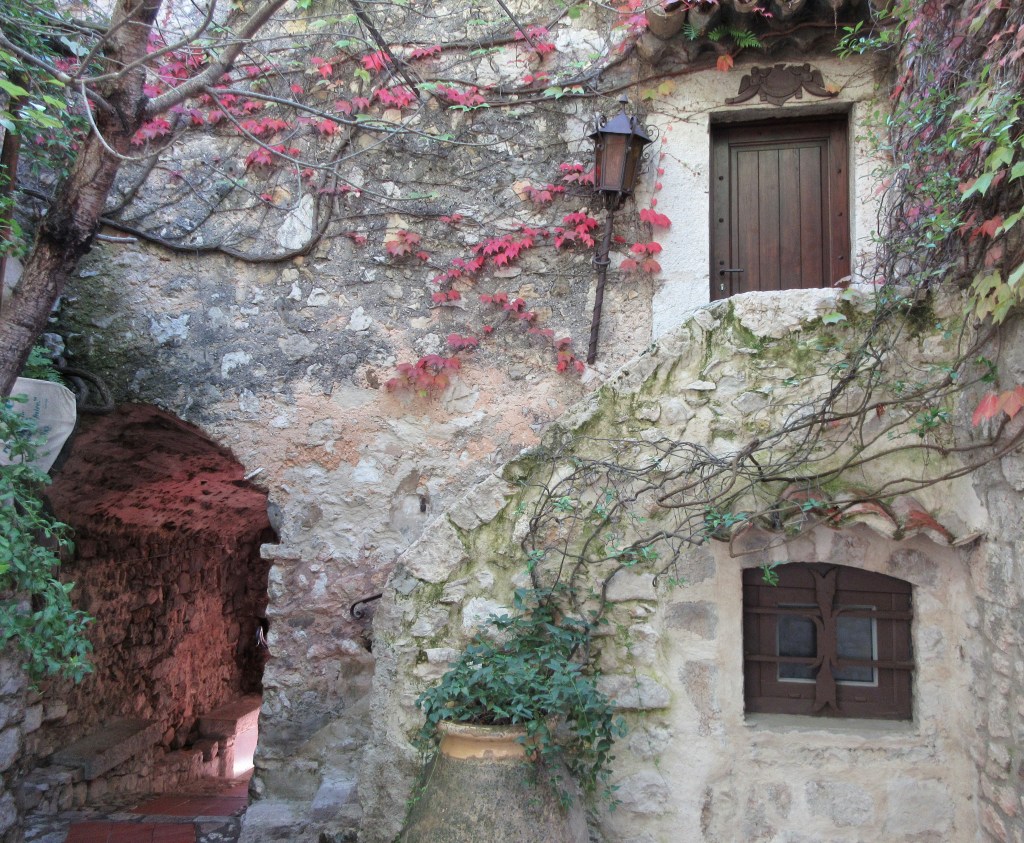
There was a makeshift market at the entrance to Eze Village, adding to the chaos. Lack of proper signage had us follow a small group of tourists partway up the hill into someone’s backyard garage. Finding the correct path up, we merged with the thick flow of other travellers from around the world. The medieval village is perched high above the town of Eze so it’s a fairly steep walk uphill.
No problem for the Gagnon’s, we’d been hiking all over Italy and France for weeks. I stepped out of the bumper to bumper foot traffic whenever I could, trying to snap pics that weren’t blocked by Asian girls posing every 6 feet. At least 30 people were in line to get tickets for the botanical gardens – the place to go for the best views around, so we passed it by and exited to a sidestreet where traffic was sparse.
I managed to get some cobbled street and cool door shots but our chosen path only took us to a fancy hotel/restaurant that was too busy to allow us in for a cocktail. Our transport to town had us arriving at lunchtime and lineups at the restaurants clogged the quaint little streets. We wandered some more and headed uphill trying to find the magnificent views. A kind shop owner said that was impossible since the high walls that blocked our view were built to keep invaders out. Unfortunately that didn’t include tourists.
We sucked it up and fought our way to the ticket booth, paying $25 to enter the botanical gardens. Dodging the same Asian girls on the way up the stairs, and purposely walking in front of their cameras, we were finally able to take in some amazing views of the Mediterranean coast, with Monaco and Cannes in the distance. Oh, and yes, there are all kinds of cacti and succulents to check out but no one seemed to be interested in the neatly manicured gardens.
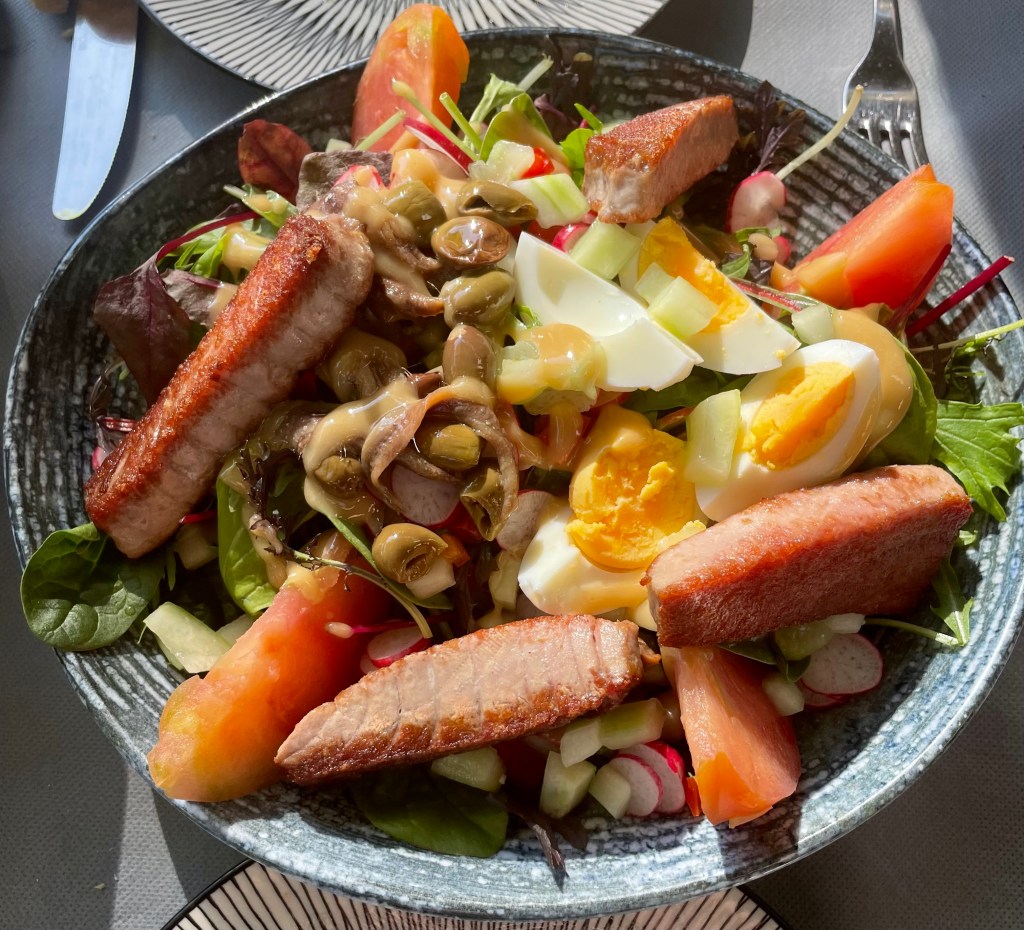
We ooed and awed at the nice views then tried to no avail to get into one of the hilltop restaurants. Parched and hungry, we walked back down to a sidewalk patio in town and paid $35 for salad. But it was the best Nicoise salad we’ve ever had, with a real tuna steak, and the beer was cold. Finishing up lunch, we eyed the 100 or so people at the bus stop waiting to leave town. That wasn’t going to happen.
Having read about a walking path that goes from the bottom of Eze Village, down to the Eze train station, I suggested we go on another adventure. It was very cool at first, literally, a shaded path on an easy grade had us strolling along admiring the forest and listening to the birds singing. Then the paved steps became crumbling concrete. Then rocks and gravel on an even steeper grade. There were several switchbacks that occasionally offered amazing sea views but it didn’t seem to get any closer.
Everyone said the walk should take about an hour. After the first hour passed our knees no longer acted as shock absorbers. We marvelled at folks older than us practically trotting down the hill and one group of teenagers with their music cranked and drinking beer. It seemed everyone was passing us. I asked Cathryn to stop at one lookout and she said, “I don’t feel like it.”
We agreed our adventure was no longer any fun. We were parched, overheated, and I was sweating like an glass of iced tea sitting in the hot sun. We caught a glimpse of the rail line but once again it wasn’t getting any closer. Eventually we arrived at sea level and saw the sign pointing up the path – someone crossed out the 1 hour and added 30 minutes. Guess we’re just old slowpokes.
Having run out of sweat and my tongue stuck to the roof of my mouth, I practically ran to the train station. There wasn’t a store or vending machine anywhere in sight – even close by in town. I used the fancy porta potty, happy to drink from the sink but it only spurted soap. There wasn’t even a hose tap on any building nearby. Fearing I’d pass out from thirst and heat exhaustion, Cathryn asked a fellow traveller if I could have some of her bottled water.
She handed me the warm bottle she’d carried from the top and went into a tirade of their walk down the hill – how she was terrified, had vertigo, and stopped to cry. They actually considered turning around at one point. Wimps. It nearly killed the Gagnon’s but we did it.
I’ve always been drawn to small medieval villages or walled-in historic hilltop towns when I travel. Admittedly, I was skeptical when Cathryn suggested Ventimiglia as one of our destinations for our 2024 trip to Italy. She had seen the town years prior during a mother-daughter trip but hadn’t visited the ‘old town’ which lay below the mountain-top resort they stayed at.
Looking for our 3rd base of operations after Lake Garda and Venice, I found us an apartment smack in the middle of the historic medieval town of Ventimiglia. With train foul-ups it was a full day ride to the last stop on our Italian adventure. We purposely worked our way south from mid-September in search of decent Autumn weather and a perch overlooking the Mediterranean Sea.
Although dusk was upon us on arrival, we were immediately in awe when the taxi dropped us in the piazza in front of a beautiful 800 year old stone church. Our apartment was only two doors away and although the stairs up to it were brutal with luggage in tow, we were blown away by the view. We had two balconies overlooking the main pedestrian street and a rooftop terrace offering a panorama of the church belltower and azure blue sea.
Too hungry from our long journey to bother unpacking, we headed back down the stairs and quickly surveyed our new neighborhood for somewhere to eat. There was a wine bar across the street and a cafe directly below our apartment but neither offered a full meal. We took a chance on a little restaurant right next to the church. Serving unique traditional dishes, it turned out to be our favorite place in town.
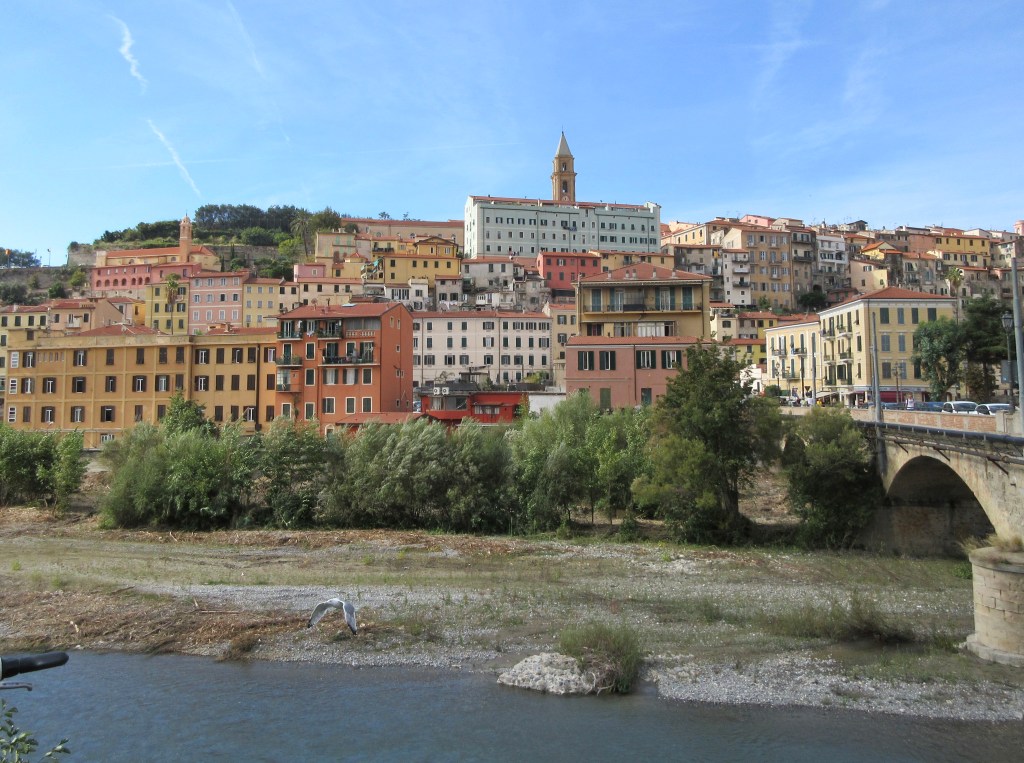
The streetlights were on when we left the restaurant, showcasing the quaint little medieval town that would be our home for the next twelve days. Ventimiglia has a population of 20k souls but I’d guess the old town has about 2k at most. The residents live mostly in 3 and 4 story buildings ranging in age from 200 to 600 years old, built right into the rock with winding and narrow streets or alleys, some barely wide enough to walk two abreast.
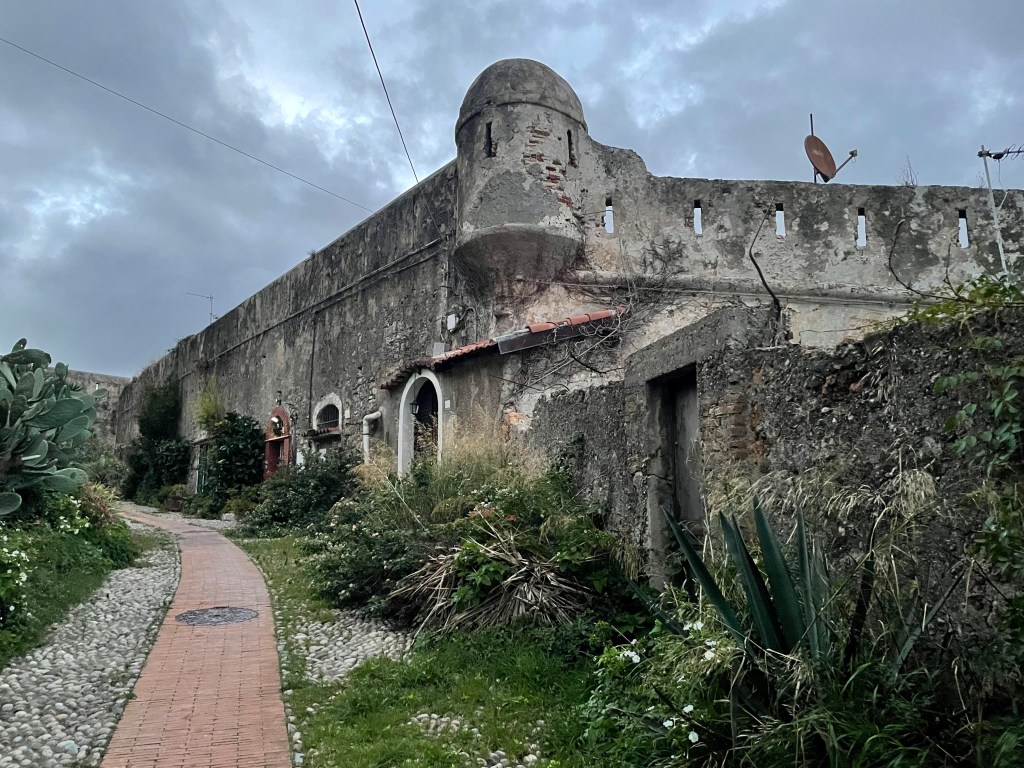
The main road up the mountain and into town stops at our doorstep, with no vehicular traffic allowed beyond that. Even Amazon has to deliver on foot. Cathryn and I has a blast exploring the old town, choosing tunnels and narrow passageways just to see where they led. The town’s ancient walls are still intact, with arched gates on three sides allowing entry. Some homes are actually built right into the wall.
Our balconies allowed us to observe everyday life in the medieval village. Like everywhere else in the world, many adults were on their cellphones. But children actually played – soccer or tag in the street or church piazza, some yelling back and forth – I think just to hear their own voices echoing off the stone buildings. There is no grass anywhere in town, but succulents do well in this climate and many homes have potted plants on their stoops or window sills.
It’s mostly men who gather at the cafe and in the street, drinking cappuccino or beer depending on time of day. Women’s presence is known by the aroma of baked goods or prepared meals wafting out of neighborhood windows. We only had to poke our noses out the balcony door to know it was dinner time. And we’ve had some awesome food, sticking to mostly traditional dishes to fully appreciate the local culture.
Cathryn and I don’t do cappuccino and croissants for breakfast every day but I’d be lying if I said we didn’t try it. With a local market only a few doors down, we ate at least half our meals in. To my dismay, bacon and eggs or even omelettes are not a breakfast staple in Italy. But fresh bread, pizza, pasta and seafood is. We had some amazing pasta dishes, even more amazing squid and octopus in warm and cold dishes. And it ain’t Windsor pizza but still very good.
Ventimiglia is only 20 minutes from the French border so it makes a good base to explore from. Nice and Monaco are within an hour by train. There are also other great Italian cities and towns close by to visit. We used an Italian rail pass but if you want to venture into France go for the 2 country or global Eurail pass. The area is easily accessible by car with easier access to small towns since bus service can be limited.
I will do my best to describe the City of Venice and what’s it’s like, but I believe it is one place in the world you should experience yourself to truly understand and enjoy just how unique it really is. Cathryn and I have both been there before but we loved it enough to visit once again for her 60th birthday year. Our plan for this trip was to skip the heavily trafficked touristy sites and take in the outer islands of Torcino, Burano and Murano.
If we stay more than one night in any location I try to book something with a kitchen, such as an Airbnb or something on VRBO so my personal chef can prepare some of our meals in. This worked well for us since breakfasts in Italy consist of pastries and coffee, one of which is bad for my waistline and the other something I’ve never consumed. Lunches were usually some type of ham sandwich while we were out exploring.
Although my chef prepared some awesome pasta dinners in, we ate many of our dinners out. Pasta and pizza are available everywhere and usually the cheaper way to go. Seafood dinners were also easy to find but many were pricey for us since 1 Euro is equal to about $1.40 Canadian. Thankfully, food tax is virtually non-existent and tipping is not customary in Italy. But many restaurants charge a 2-3 Euro service fee to make up the difference.
Venice. Some call it the floating city but it’s actually built on reclaimed land in a lagoon, on thousands and thousands of wood pilings. It explains the lack of trees. Experts blamed those same foundations as the reason for Venice’s sinking but it’s now been discovered they’ve drained underground aquifers for centuries to get drinking water, causing the city to sink. Higher sea levels and advancing tides also invade the city, meaning Venice’s life expectancy is limited.
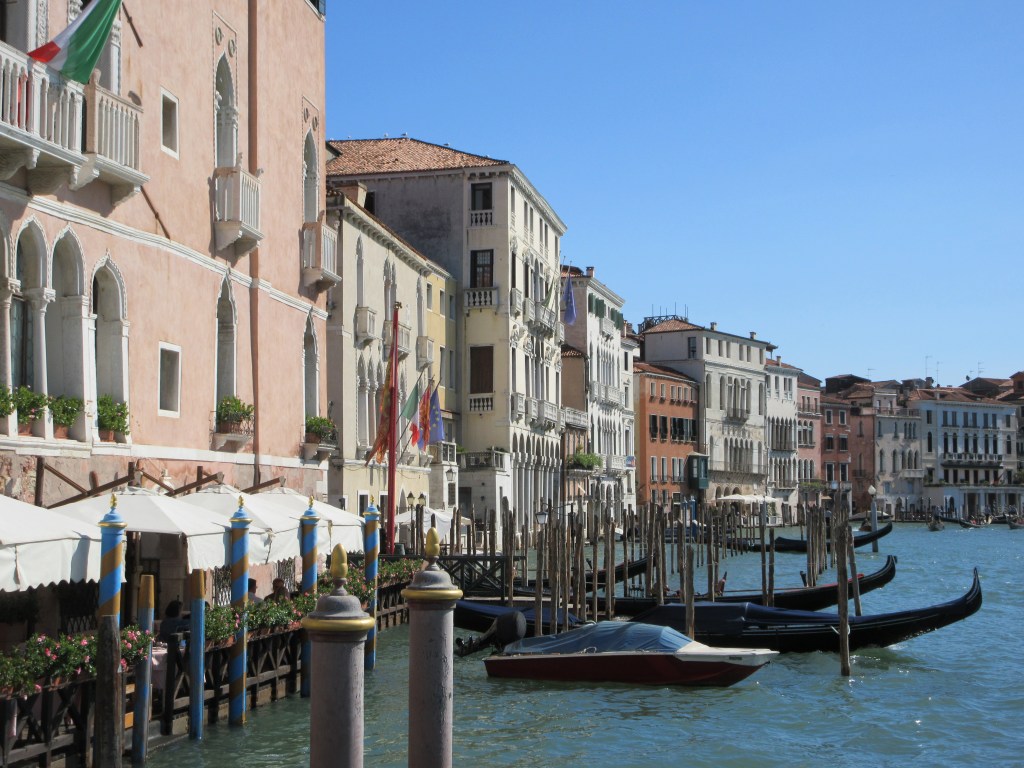
Venice. You won’t experience such a unique city anywhere else in the world. Once a place where people in the 5th century fled to avoid Barbarian conquerors, it later became a major trading hub for fish and salt and by the 9th century it had become a major maritime empire. Arriving in Venice by the Grand Canal, which snakes it’s way through the center of the city, you can still witness the magnificent palaces and buildings showcasing Venetian prosperity.
Nowadays, Venice makes it’s money from mass tourism. It’s gotten so bad that the city had forbidden large cruise ships and they charge a visitation/tourist tax. But it’s still a really cool place to visit, especially if you like history, ancient Byzantine and Baroque architecture, palaces, churches, canals, and Italian food.
Try to imagine a place where there are no front lawns, only water. No cars or trucks. You get everywhere by foot or boat. Even mass transportation is by waterbus, called vaporettos. Those with deep pockets can hire beautifully varnished watercraft, and some locals own their own boats to get around. Everything in Venice moves by water and the canals – people, food, and garbage.
The city is known for it’s gondolas, a hand-crafted canoe of sorts that has become a must-do thing for visiting tourists. The boats costs thousands of dollars to build and gondoliers go through a 4 year training course to master their trade. Some serenade their fares while rowing and weaving their way through various canals. Our apartment overlooked one canal and we watched wide-eyed tourists and even wedding parties go by. It was way better than the cars and trucks that roared by daily at our last place.
Our plan to visit the outer islands made for a perfect visit. We took the vaporetto to Torcello first, a little over an hour away but well worth the trip. Leaving at a popular time of day, our boat was quite packed until the last leg. The island is where it all began, where the Venetians started to build in the lagoon. The cathedral was built in the 7th century and is one of the oldest churches is Italy. Exploring the island left me puzzled, trying to figure out how 20,000 people once lived there. Now there are only 12.
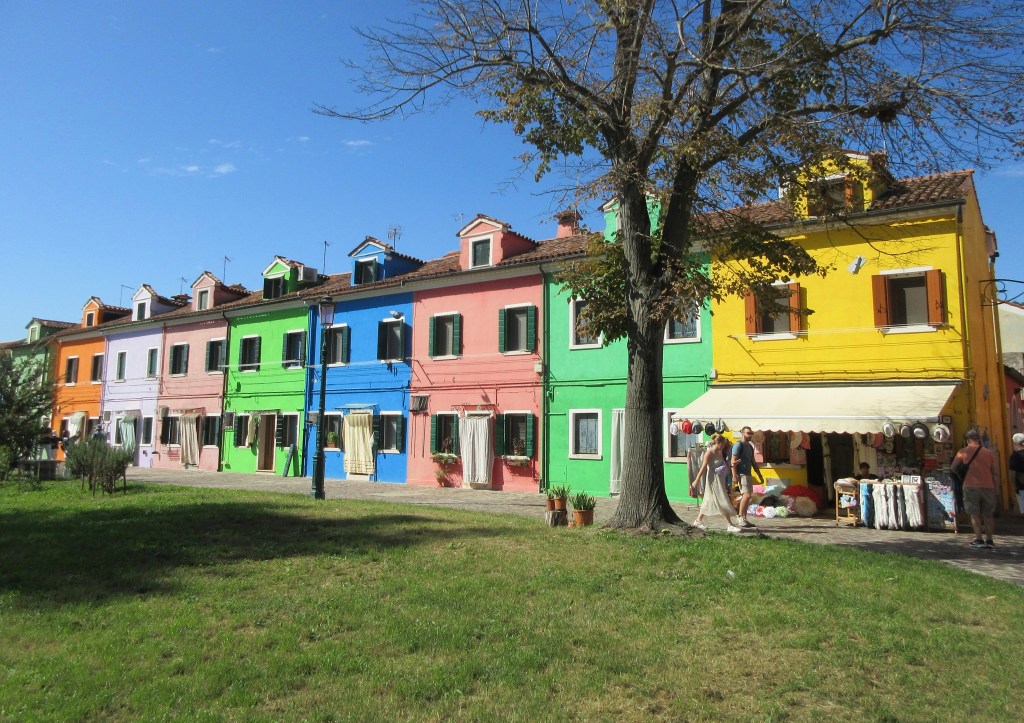
Burano was our next island stop and it completely blew us away. It is easily the most colourful place we’ve ever visited – houses, shops and buildings are all stuccoed or painted in various pastel colours, making neighborhoods look like rows of saltwater taffy. Like the main Venice island, Burano also has canals and plenty of pedestrian only streets to explore. For Cathryn and I, it is our favorite Venetian island.
We visited the island of Murano too but were hard-pressed to be wowed after seeing Burano. But if you’re into hand-crafted Venetian glassware, Murano is the place to go. There are several glass blowing factories to visit and hundreds of stores selling everything from fancy chandeliers to miniature glass ballerinas. The glassware is impressive but the canals and buildings are similar in size and construction to those scattered across the City of Venice.
I conclusion, having been to Venice myself on two previous occasions I wasn’t too excited to see it again. But just as it was on my very first visit, the city grows on you. The heavily-trafficked touristy sites are definitely worth seeing for the first time. But the back streets (like the Jewish Ghetto) take you back in time, where neighbours gathered in piazzas or courtyards. Children without electronic devices, boys playing football and girls skipping rope. Men gathered to drink coffee or beer and women working in the kitchen sending wonderful aromas out the window to passerby.
Italy is a large country with several beautiful regions to explore. Cathryn and I have been mostly exploring the northern regions and more specifically on the first part of this trip, Lake Garda. It’s the largest of Italy’s lakes, situated in the north and fed by some of the meltwater from the Swiss and Italian Alps. We’d covered much of Lake Como on our last Italian visit but this time we planned to explore Garda and it’s surrounding medieval towns.
We chose the town of Garda as a base, situated on the eastern shore of the lower half of the lake, with plenty of other towns close enough to explore with simple day trips by ferry or bus. Garda Town was the perfect size for us, easily walkable and fun to explore with cobbled pedestrian-only streets, some of which linked piazzas with tunnels under ancient buildings.
Garda has plenty of restaurants serving all sorts of foods, mostly specializing in seafood, pasta and pizza. Funny, no matter what kind of a menu they offer, every single eatery serves pizza. That includes focaccia and bruschetta-sized pizza so budget-minded travellers can afford reasonably priced meals. Most costs were similarly priced to home, more compatible to the American dollar since it is almost at par with the Euro.
Cathyn tells me that prices for clothes and genuine Italian leather goods are way more reasonable than in major tourist centers like Rome or Naples or the Amalfi coast. Ferry tickets between towns on the lake got pricey for longer distances, like the Town of Limone which is at the top of the lake and two hours away. The train stops at Peschiera, on the bottom of the lake so you have to rely on lake ferries or local buses. Taxis and even Uber are very expensive.
There are plenty of walking or hiking paths in the area, with some other towns easily reached on foot. We walked along the lake to Bardolino and then to the cool little town of San Vigilio, where we witnessed a Calvin Klein photoshoot. Both were easy lakeside walks, reachable in about 45 minutes. We also took the ferry to Lazise, Torri del Benaco and Sirmione, all within an hour or so boat ride. Because of heavy road traffic around the lake, the ferries are much more punctual than buses.
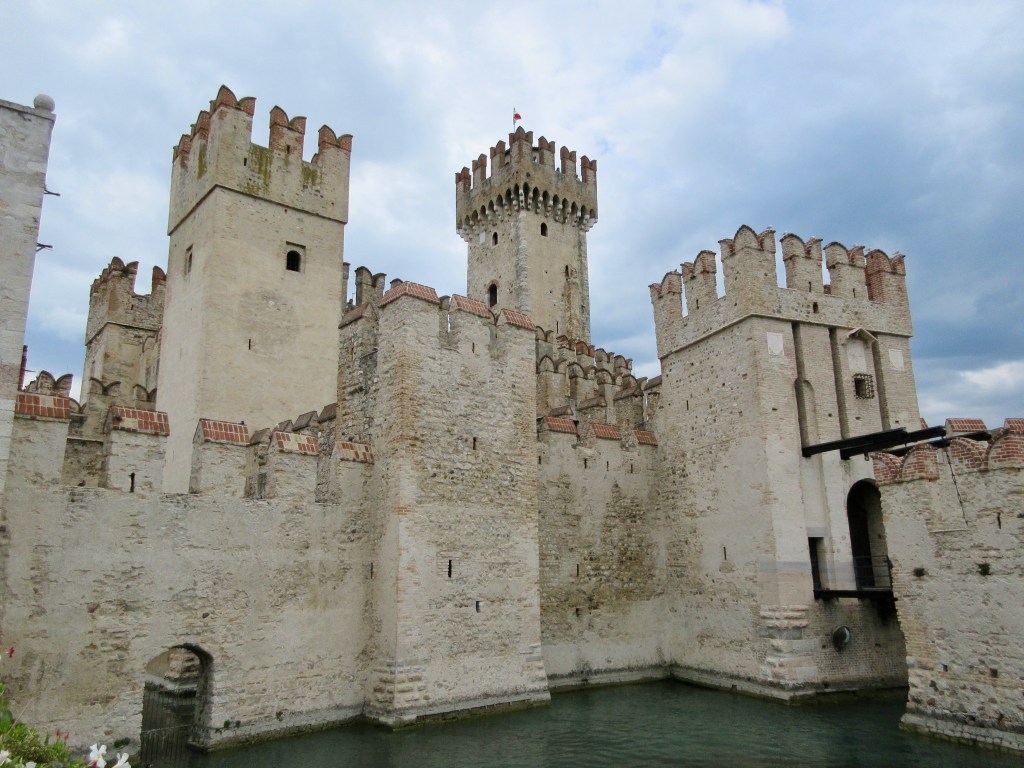
One might think that all medieval towns are the same – you’ve seen one castle town – you’ve seen them all, but we found it wasn’t so. Each town was unique in it’s own way, some walled in by an old fortress and some showcasing their castle as a historic old town centerpiece. Crowds were heavier than we expected for the so-called shoulder season, with getting around much easier early or late in the day. I can’t even imagine how crazy it would be here in summer.
People all over the world visit Italy and Lake Garda, but we found this is the time of year when 80% of tourists are German. And oddly enough, those we encountered were the they most arrogant and rude people we’ve ever met. More so than any Germans we know or have met in Germany. They blatantly cut queues for the ferry or bus, sometimes shoving their way through, and they thought nothing of smoking at a table 10 inches away while eating meals. Never did they offer an excuse me or hello or even a smile.
We had a mixed bag of weather, with a few more clouds and rain that normal, but we managed and only had to don a raincoat or umbrella a couple times. It was sporadic – we had a picture perfect day in Torri del Benaco, while friends we met got rained on all day in another town only 10 miles away. Temperatures were comfortable, depending on sun or cloud, anywhere between 15 to 25 degrees day or night.
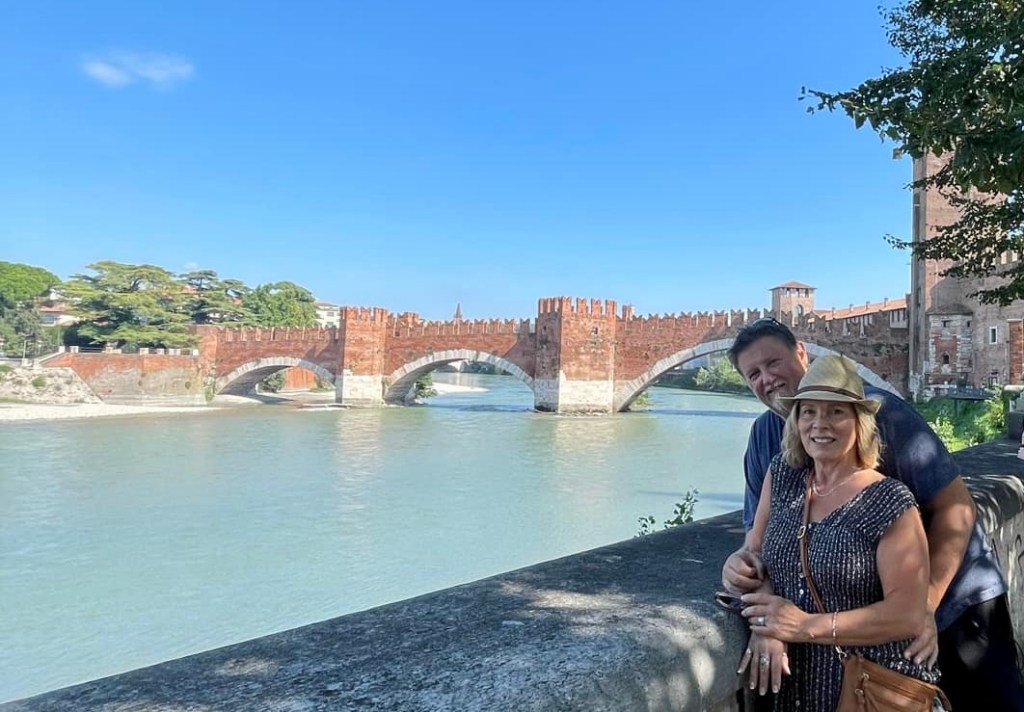
If you like lakeside retreats, mountain views, historic small towns with medieval sites all within a couple hours of each other, put Lake Garda on your bucket list. We also visited Verona, only about an hour from Garda Town, but that’s another story.
Mass tourism has become a taxing and ugly thing for many countries, cities, and famous sites around the world. With the advent of the Internet, they say the world has become a smaller place. Add the ease of air travel and other modes of transportation along with human curiosity, and one can see why the masses have ventured out from their own backyards to seek out unique and fantastic places to visit.
Cathryn and I were ‘travellers’ long before we met each other. She was lucky enough to do several trips with her family. Mine was larger without the money for that kind of thing but my brother and I managed a trip to Florida with my mother and her boyfriend once we had a job and were able to pay our own way. After securing my career as a police officer, I used my pay cheque for a motorcycle trip back down to the sunshine state.
My wanderlust and thirst for travel continued with trips throughout Canada, the U.S., Europe, Mexico and the Caribbean Islands. I did one cruise because of the unique ports of call but didn’t like scheduled meals and events on board, as well as the process of trying to get hundreds of people on and off the ship every time it docked. We relied on travel agents and ‘packaged’ tours back then, with our absence from work limited by allotted vacation time.
Retirement rewarded me with unlimited time to travel. One or two-week vacations became a month or more, allowing me to venture further abroad for longer. Changing with age and the times, I went from backpacking around Europe to flashpacking (backpack on wheels) in Southeast Asia and South America. Solo motorcycle trips up, down, and across North America evolved into trips for two, with Cathryn joining me on the Harley.
I’d found my life partner, with similar tastes in music, food, travel and life itself. Once Cathryn retired, the world was ours to discover. And at that we’re doing our best. For us, seeing new places and experiencing different cuisine and culture is what life in is all about. Being financially secure, our only travel limitation seem to be there as so many places to visit and not enough time to see them all.
I have a travelling friend who emigrated from Canada to Cambodia, where he settled and started a family. As a fellow traveller, he often sought out places off the beaten path that hadn’t been discovered by the masses or had fallen victim to overtourism. Up until about twenty years ago, I hadn’t found crowds to be a problem in my travels to other countries around the world. For the most part, tourists seemed to be happy sticking with the tried and true destinations where everyone else had been or was going.
But the world truly has gotten smaller, with more people venturing further away from home, seeking out exotic places they’ve seen on television or on the Internet. Places that were once considered off the beaten path or undiscovered by the masses. Hoards of vacationers and travellers alike have taken to road, rail and air, in search of cool places they had only previously dreamed of.
Now that the masses have converged on those very places, destinations have become overcrowded and almost unbearable to travellers and locals alike. For us it means higher prices or limited availability for transportation and lodging. For them it means hoards of travellers invading their home towns and neighborhoods. Where tourism was once good for local economies, it is now taxing public services and infrastructure.
Cathryn and I witnessed such a mass invasion firsthand in Dubrovnik, Croatia, a once small fishing village made famous by the Game of Thrones tv series. We were enjoying a quiet stroll along the top of the city walls when we saw a cruise ship pull into the harbour. By the time we came down from the wall, the small medieval town had been invaded by five thousand tourists, all trying to find famous sites they’s seen on the tube.
People from the cruise ships pay good money for those types of excursions. I had to laugh when I saw hungry tourists scouring the old town trying to discover the magical places they saw on their favorite show. The group was disappointed when their tour guide explained how almost every backdrop they’d seen on tv was computer generated.
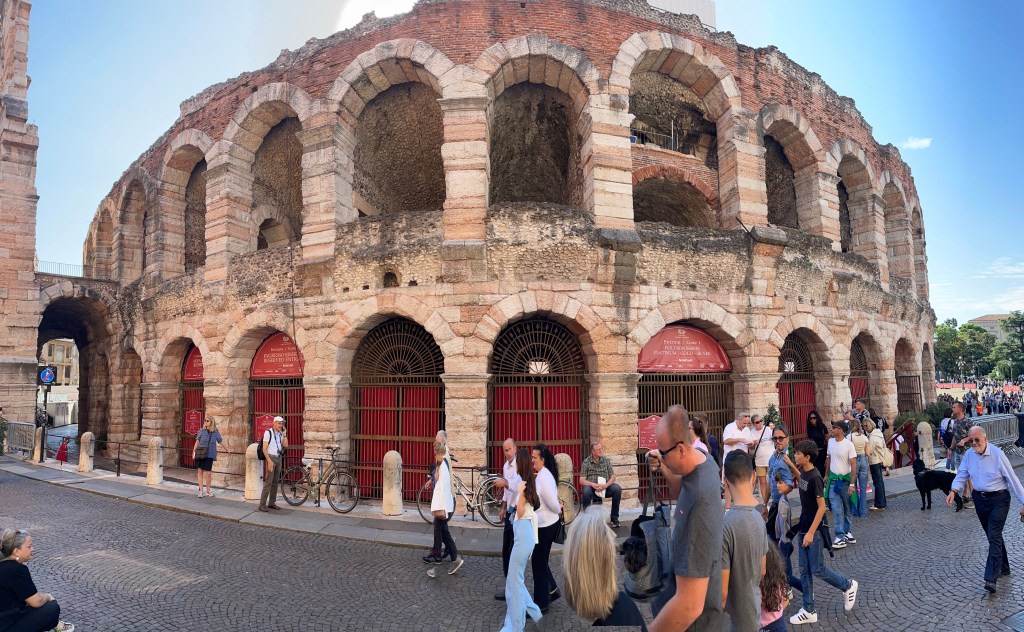
We are currently in Italy where crowds have varied from town to town. We chose the shoulder season – September and October, purposely to avoid the masses. But that wasn’t the case in Verona, where we’d considered seeing the famous ‘Juliette’ balcony. Although the character and story are fictional, it doesn’t stop thousands of tourists from reserving a spot online in advance to visit the site and have a chance at rubbing a breast on her statue for good luck.
We did not see the balcony or broze-breasted statue, but did manage a peak at the alley leading to it from our city tour bus, surrounded by thousands of tourists. What’s really funny, besides the love story being fictional, is that Shakespeare basically plagiarized the tale from other poets. It’s also never been proven he actually set foot in Verona, let alone Italy.
So, if you plan to travel, beware of mass tourism. Venice doesn’t allow cruise ships in the harbour anymore and charges by the day to enter the city. Locals have complained their neighborhoods are now full of foreigners staying in rentals. Santorini, Greece becomes gridlocked when several thousand cruise ship tourists try to cram into the tiny fishing village to get that perfect selfie.
Barcelona and Malaga, Spain, are now passing bylaws to limit the number of vacation rentals in heavily travelled tourist destinations. Perhaps this comes as a result of post Covid travellers trying to make up for lost time, but I think not. It seems to me more and more people in the world now have itchy feet and have discovered their dreams and wanderlust can become reality.
An entertaining read, action-packed and fast paced, but all too predictable. The familiar story…an elite special force sets out to save the world, getting hunted, shot and or stabbed along the way. Count on at least one or two of the secondary characters getting bumped off but the mai characters save the world at the very last minute (not really a spoiler alert) and live happily until the next mission comes along. Rollins is a good author but he’s relied on the tried and true method of telling the same old story to secure readers. Personally, I prefer something out of the ordinary to pique my interest. Having said that, I did enjoy the material about matter from outer space and the many things we really don’t know about our own universe.
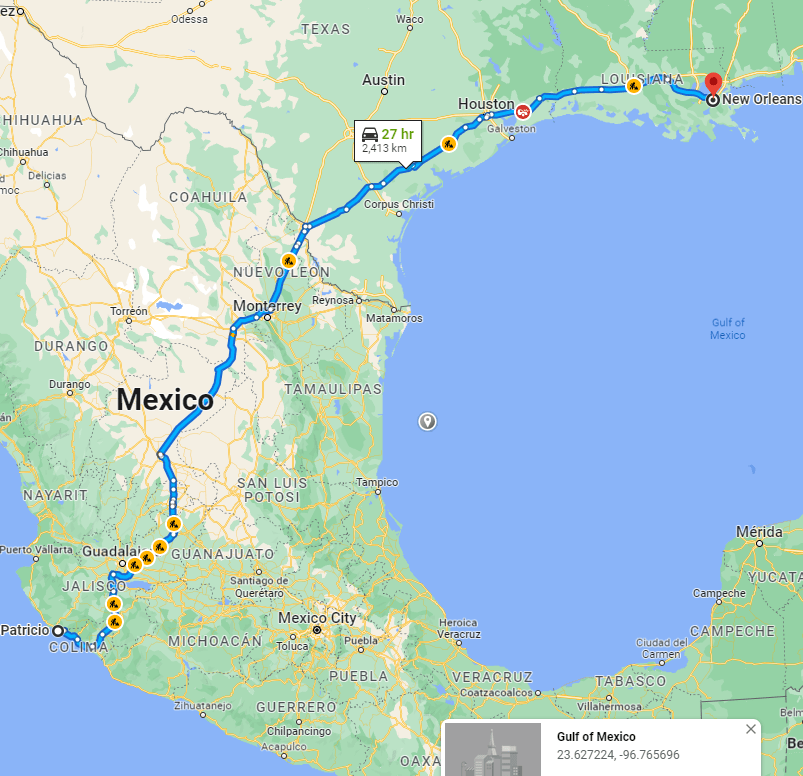
Anyone who understands my travel habits knows how I hate to take the same route twice, even when returning from a particular destination. So, why would our return trip from Mexico be any different. If you read my post, Snowbirds Who Drove to Mexico, you got to see how it really is possible to drive there, and see some cool stuff along the way.
They say, what goes up must come down. But in our case we did it in reverse, driving back home from Mexico and taking a completely different route to get there. After six days of 8 to 10 hour drives on the way down, we slowed things down a bit on the way home, taking 7 days instead. Daily stopovers were chosen in advance for peace of mind.
To prep the Silver Bullet for the trip home I attended the local outdoor car wash for an in and out. I had them check the air filter, top up my fluids, and repair a sticky hood latch. All for the scandalous price of $12 Canadian.
From out winter home in Melaque, on the Pacific coast. we chose the town of Tonala as our first stop. It’s kind of a suburb, southeast of Guadaljara. We chose this stop as a place to shop, hearing that it is the place to go in Mexico for wholesale and bargain prices on everything from furniture to artwork. Our car was already quite full, but we managed to stuff in a large mirror, tin sunburst for our patio, and a set of handblown glasses, all for a fraction of what they would cost anywhere else.
We spent the next night in Saltillo, an automotive town just south of Monterrey. For safety-sake we never travelled at night and mostly stayed on the larger toll roads or highways. The drive was fairly uneventful until we hit a large rock and blew a tire, in the middle of nowhere. No problem, we thought, we had full coverage Mexican car insurance that included flat tires.
While I checked the damage, Cathryn called the emergency numbers for roadside assistance. No answer at one and a message from the other stating to call back during normal business hours. Another call to the Green Angles (roadside help) also went unanswered. Seems nobody was working on Saturday. I had the trunk empty by the time she got off the phone and found the spare tire.
Thankful that I took auto mechanics in high school, I was able to figure out the newfangled jack and how to change the blown tire. Problem #1 solved. Our GPS found a Goodyear about a half our away but they closed for their 3 hour siesta around the same time. Problem #2. Driving above the recommended speed limit on the ‘donut’ spare, we made it just in time.
After some discussion with the garage manager, with both of us faking each other’s language, he agreed to the repair. He and the tire jockey had their own discussion about working overtime to take care of us. With the new tire is was easy sailing to the U.S. border, until we got stopped for speeding about 15 miles shy of America. 117 in a 60. Shit!
Now, you have to understand that we never encountered a speed trap anywhere in Mexico the whole three months in country, and for the most part I didn’t think police could afford radar guns. I’d heard stories of them using hair dryers to extort money from gringos, but I’ve seen my share of radar guns and got to see the digital readout for myself.
Add another 200 bucks to the cost of travel. There are few posted signs in the area, where it seems the cops prey mostly on the heavy truck traffic heading for the border. Perhaps the Silver bullet set a new land speed record. I never saw a 60k sign, I swear. They call that racing here at home. The border was a welcome site and we headed for New Orleans.
Our first stop in the U.S. was in Sugarland, just south of Houston, where we found a hotel near a Rudy’s Smokehouse. We’d stopped at one near Austin on the way down and had to do a repeat for some Texas Barbeque. No more tacos! Highway signs in Louisiana for Boudin and Crackling got the best of us and we stopped to check out the local snack food. The latter being something like pork rinds with some meat still attached, and sprinkled with cajon spice.
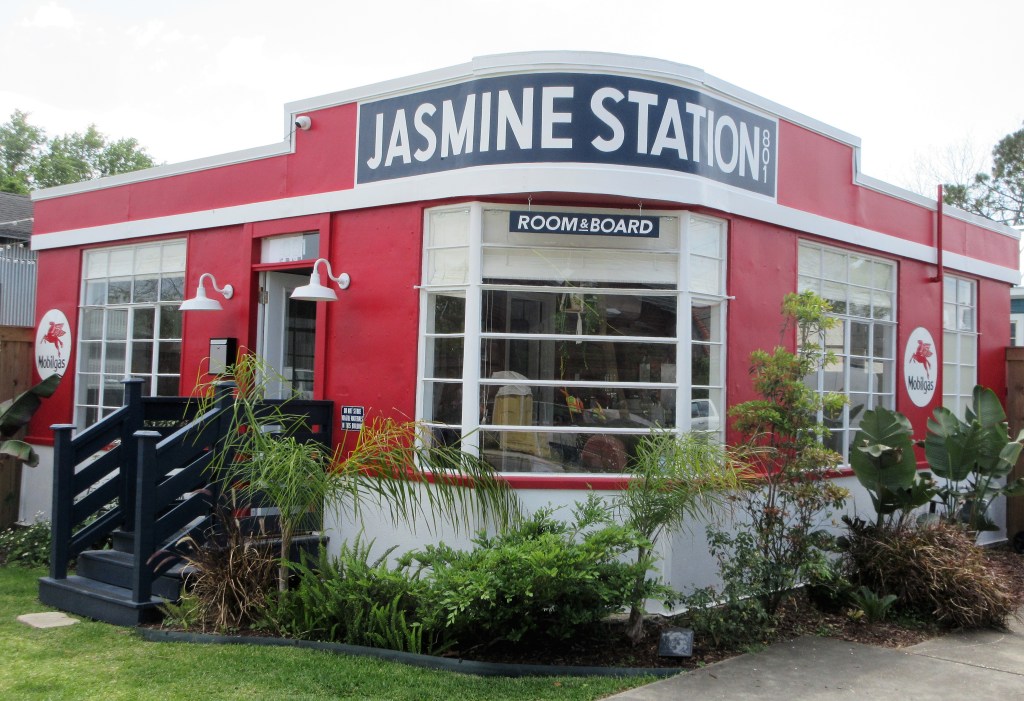
Our Airbnb
From there we were able to get into New Orleans early the next afternoon, where we found the coolest Airbnb in Algiers Point, across the Mississippi River from downtown NOLA. Only a 5 minute ferry ride from Canal Street, we were blown away by our quaint little neighborhood, with it’s colorfully painted shotgun style houses and eclectic cafes and restaurants. Our Airbnb was actually an old gas station at one time.
I’d been to NOLA once before but Cathryn hadn’t so we started with a trolley tour along Canal Street, then through the Garden District to ogle the fine mansions. We got off in the French Quarter and took in touristy things like beignets at Café du Monde, the waterfront, and Bourbon Street. We chowed down on Willie’s Fried Chicken while listening to live music on Frenchman Street.
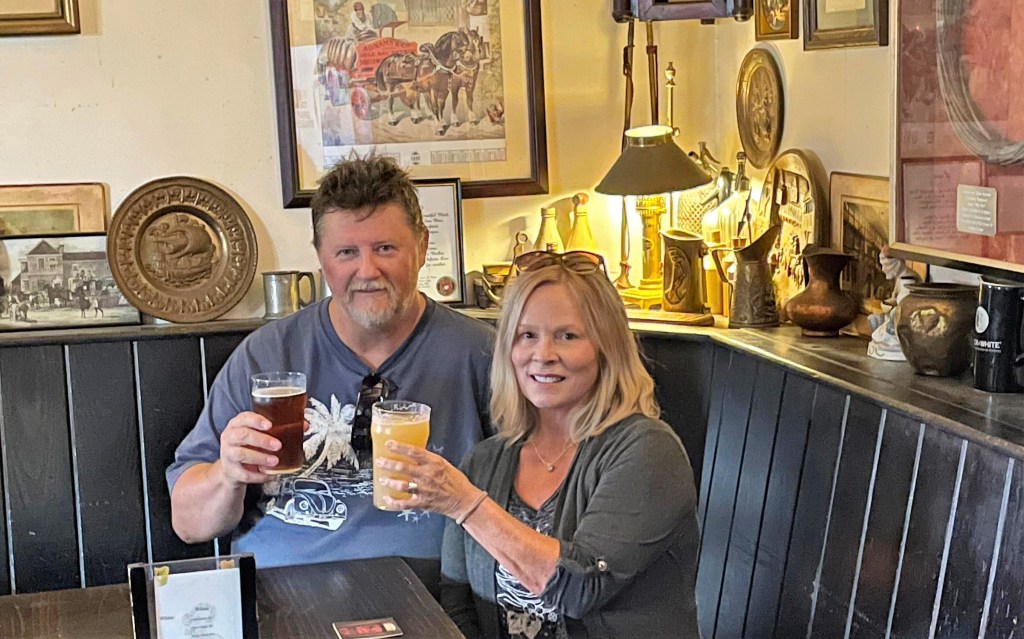
Crown & Anchor English Pub
The best meal we had was back across the river at the Dry Dock Cafe, where we sampled Alligator sausage, seafood gumbo, a turkey Po Boy, and bread pudding. Our best breakfast was also in Algiers Point at the Tout de Suite Cafe, where we also scored a cool piece of stained glass art. They say NOLA is all about music and food. We ate our share and Cathryn gave her leftovers to hungry street people.
Our last night was spent along the Interstate, somewhere, less than a day’s drive from home. Most of the Covid bullshit was over by the time we hit Canada, and only had to produce our passports. With our side trips in Mexico we did a total of about 10,000 kilometers or 6,000 miles. Cheers to the Silver Bullet.






















 Life Written and Reviewed