

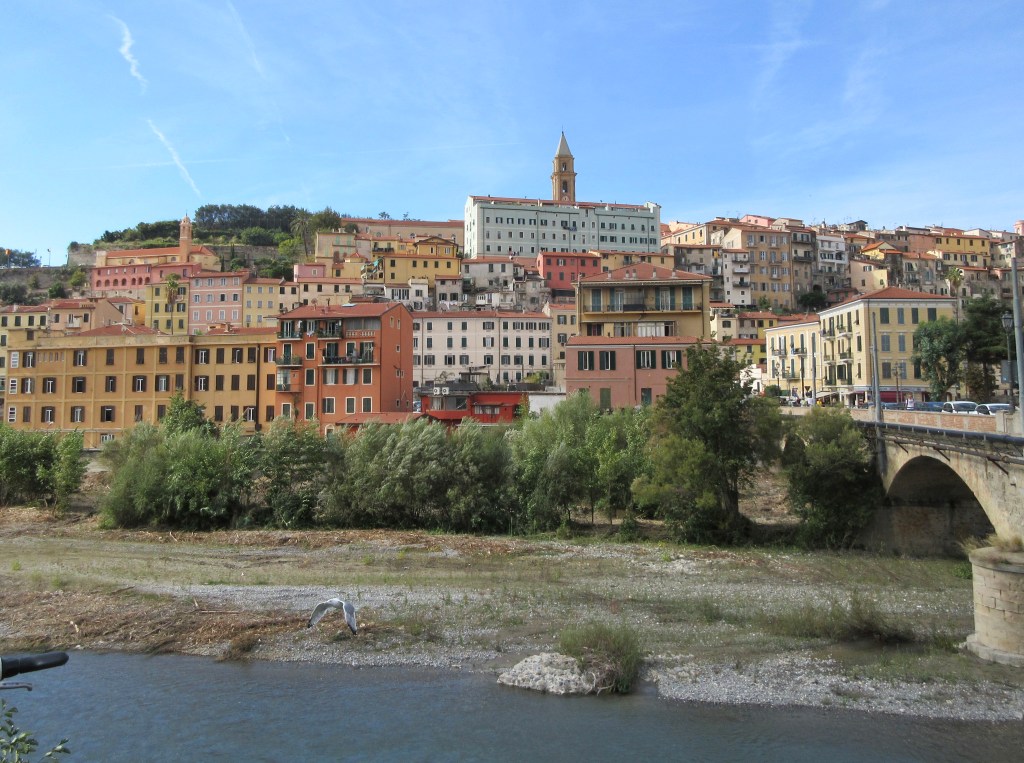
I’ve always been drawn to small medieval villages or walled-in historic hilltop towns when I travel. Admittedly, I was skeptical when Cathryn suggested Ventimiglia as one of our destinations for our 2024 trip to Italy. She had seen the town years prior during a mother-daughter trip but hadn’t visited the ‘old town’ which lay below the mountain-top resort they stayed at.
Looking for our 3rd base of operations after Lake Garda and Venice, I found us an apartment smack in the middle of the historic medieval town of Ventimiglia. With train foul-ups it was a full day ride to the last stop on our Italian adventure. We purposely worked our way south from mid-September in search of decent Autumn weather and a perch overlooking the Mediterranean Sea.

Although dusk was upon us on arrival, we were immediately in awe when the taxi dropped us in the piazza in front of a beautiful 800 year old stone church. Our apartment was only two doors away and although the stairs up to it were brutal with luggage in tow, we were blown away by the view. We had two balconies overlooking the main pedestrian street and a rooftop terrace offering a panorama of the church belltower and azure blue sea.
Too hungry from our long journey to bother unpacking, we headed back down the stairs and quickly surveyed our new neighborhood for somewhere to eat. There was a wine bar across the street and a cafe directly below our apartment but neither offered a full meal. We took a chance on a little restaurant right next to the church. Serving unique traditional dishes, it turned out to be our favorite place in town.
The streetlights were on when we left the restaurant, showcasing the quaint little medieval town that would be our home for the next twelve days. Ventimiglia has a population of 20k souls but I’d guess the old town has about 2k at most. The residents live mostly in 3 and 4 story buildings ranging in age from 200 to 600 years old, built right into the rock with winding and narrow streets or alleys, some barely wide enough to walk two abreast.

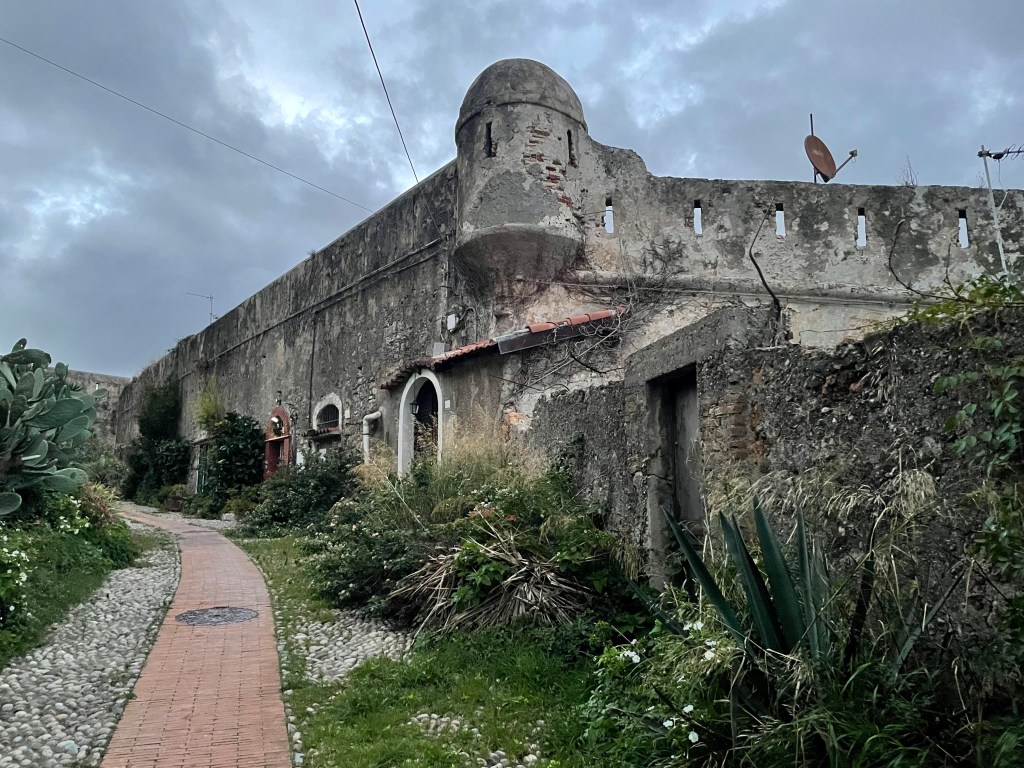
The main road up the mountain and into town stops at our doorstep, with no vehicular traffic allowed beyond that. Even Amazon has to deliver on foot. Cathryn and I has a blast exploring the old town, choosing tunnels and narrow passageways just to see where they led. The town’s ancient walls are still intact, with arched gates on three sides allowing entry. Some homes are actually built right into the wall.
Our balconies allowed us to observe everyday life in the medieval village. Like everywhere else in the world, many adults were on their cellphones. But children actually played – soccer or tag in the street or church piazza, some yelling back and forth – I think just to hear their own voices echoing off the stone buildings. There is no grass anywhere in town, but succulents do well in this climate and many homes have potted plants on their stoops or window sills.
It’s mostly men who gather at the cafe and in the street, drinking cappuccino or beer depending on time of day. Women’s presence is known by the aroma of baked goods or prepared meals wafting out of neighborhood windows. We only had to poke our noses out the balcony door to know it was dinner time. And we’ve had some awesome food, sticking to mostly traditional dishes to fully appreciate the local culture.

Cathryn and I don’t do cappuccino and croissants for breakfast every day but I’d be lying if I said we didn’t try it. With a local market only a few doors down, we ate at least half our meals in. To my dismay, bacon and eggs or even omelettes are not a breakfast staple in Italy. But fresh bread, pizza, pasta and seafood is. We had some amazing pasta dishes, even more amazing squid and octopus in warm and cold dishes. And it ain’t Windsor pizza but still very good.
Ventimiglia is only 20 minutes from the French border so it makes a good base to explore from. Nice and Monaco are within an hour by train. There are also other great Italian cities and towns close by to visit. We used an Italian rail pass but if you want to venture into France go for the 2 country or global Eurail pass. The area is easily accessible by car with easier access to small towns since bus service can be limited.


 Life Written and Reviewed