
Ezze – Must-see or Tourist Trap

I’d been to Eze thirty-something years ago while visiting a friend in Nice, France, but couldn’t remember much about it other than it was a hilltop village with cool little artisan shops and awesome views of the Mediterranean and surrounding area.

Since we were staying in Ventimiglia, Italy, less than an hour away, Cathryn and I decided to visit the highly rated tourist attraction. Her friends raved it was their most favorite place in the world. Not having a car at our disposal, we had to rely on trains and buses to get to Nice and Eze. That had proved challenging so far, with a train strike in the area and irattic bus schedules.

Getting on the train to Nice, I noticed there are three different stations and though online information said to catch the Eze bus in Nice, they left out the part about which stop to get off. A kind traveller sitting next to me helped us out and confirmed the bus number I had and that it was a ten minute walk to another bus station where our bus ran from.

As usual, our Apple map app had us going in circles around a roundabout when I saw some other tourists hopping into a rideshare van. They only had room for one but one of the passengers said we could take the #82 bus and she pointed over her shoulder. If not for her we would have done another lap around the roundabout.
We only had to wait 10 minutes and happily boarded the bus to Eze. We chatted with a lovely couple from Minnesota and barely noticed the ride until one particular stop where about 40 more people tried to pack onto our bus. Thankfully, we’d gotten on at the right stop and didn’t have to stand for the entire ride. Arriving in Eze and trying to get off the bus while 40 more people pushed and shoved to try and get on, my heart sank.

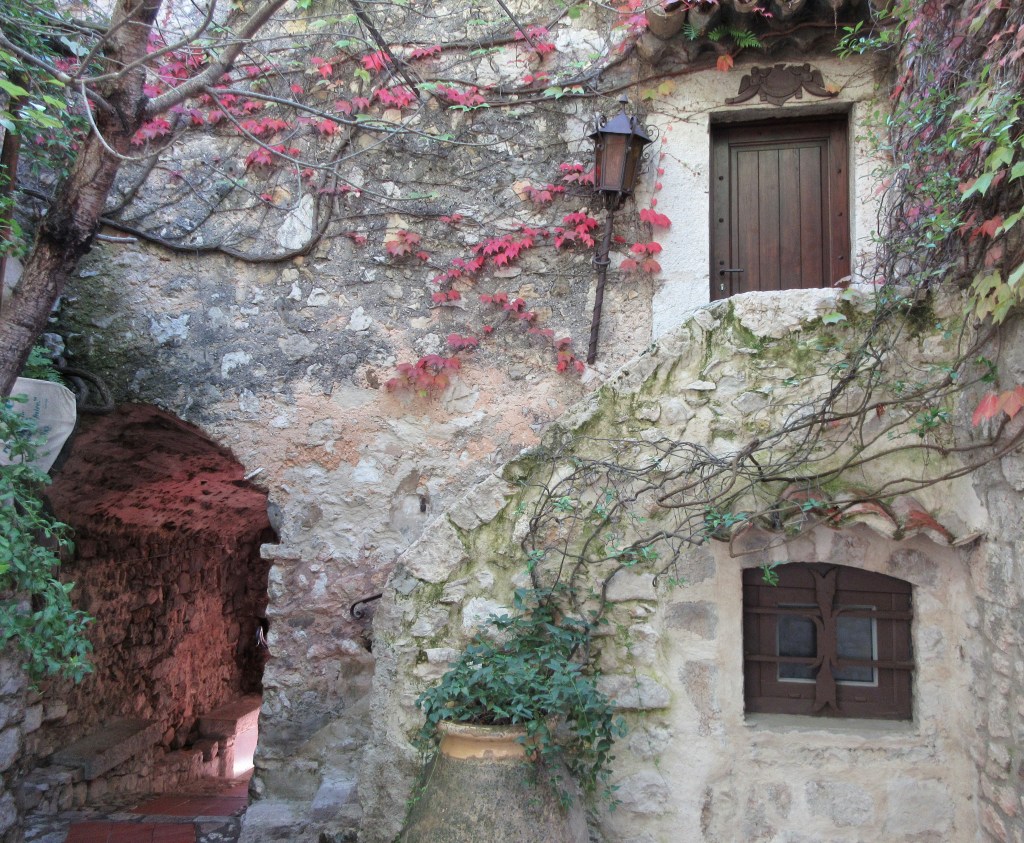
There was a makeshift market at the entrance to Eze Village, adding to the chaos. Lack of proper signage had us follow a small group of tourists partway up the hill into someone’s backyard garage. Finding the correct path up, we merged with the thick flow of other travellers from around the world. The medieval village is perched high above the town of Eze so it’s a fairly steep walk uphill.

No problem for the Gagnon’s, we’d been hiking all over Italy and France for weeks. I stepped out of the bumper to bumper foot traffic whenever I could, trying to snap pics that weren’t blocked by Asian girls posing every 6 feet. At least 30 people were in line to get tickets for the botanical gardens – the place to go for the best views around, so we passed it by and exited to a sidestreet where traffic was sparse.

I managed to get some cobbled street and cool door shots but our chosen path only took us to a fancy hotel/restaurant that was too busy to allow us in for a cocktail. Our transport to town had us arriving at lunchtime and lineups at the restaurants clogged the quaint little streets. We wandered some more and headed uphill trying to find the magnificent views. A kind shop owner said that was impossible since the high walls that blocked our view were built to keep invaders out. Unfortunately that didn’t include tourists.

We sucked it up and fought our way to the ticket booth, paying $25 to enter the botanical gardens. Dodging the same Asian girls on the way up the stairs, and purposely walking in front of their cameras, we were finally able to take in some amazing views of the Mediterranean coast, with Monaco and Cannes in the distance. Oh, and yes, there are all kinds of cacti and succulents to check out but no one seemed to be interested in the neatly manicured gardens.

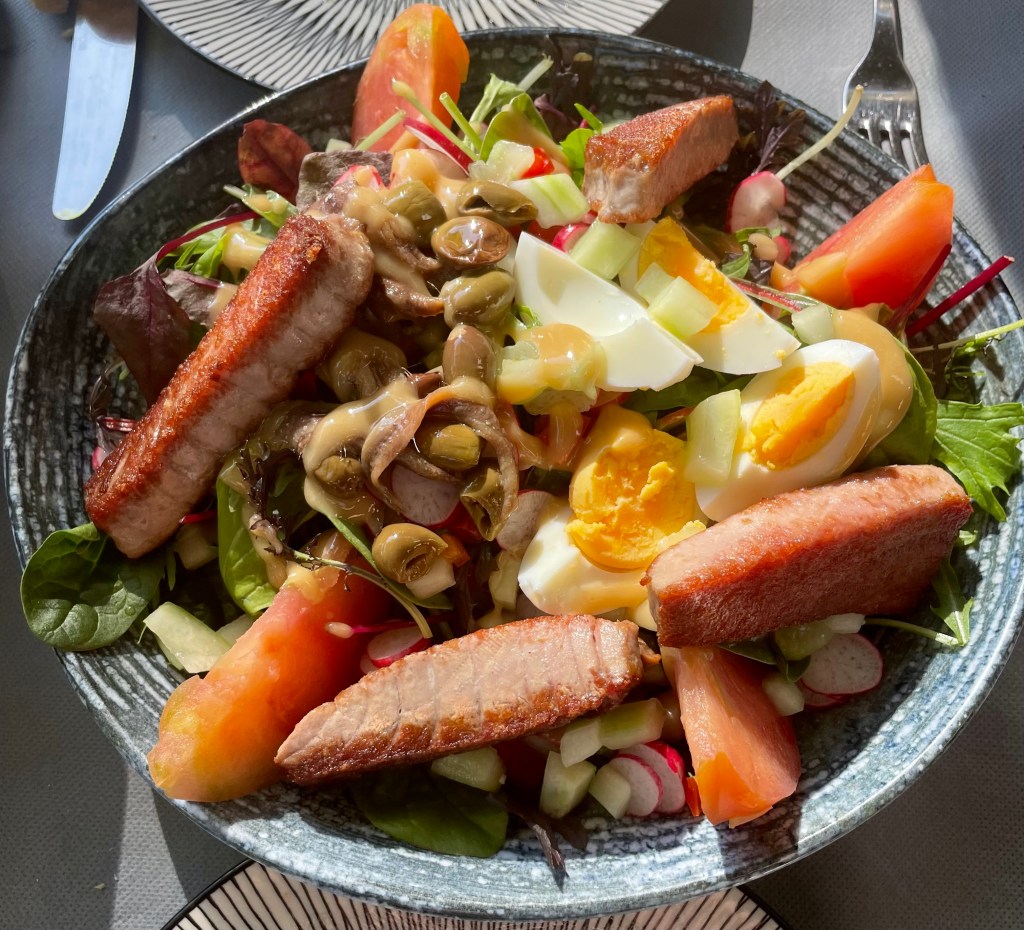
We ooed and awed at the nice views then tried to no avail to get into one of the hilltop restaurants. Parched and hungry, we walked back down to a sidewalk patio in town and paid $35 for salad. But it was the best Nicoise salad we’ve ever had, with a real tuna steak, and the beer was cold. Finishing up lunch, we eyed the 100 or so people at the bus stop waiting to leave town. That wasn’t going to happen.
Having read about a walking path that goes from the bottom of Eze Village, down to the Eze train station, I suggested we go on another adventure. It was very cool at first, literally, a shaded path on an easy grade had us strolling along admiring the forest and listening to the birds singing. Then the paved steps became crumbling concrete. Then rocks and gravel on an even steeper grade. There were several switchbacks that occasionally offered amazing sea views but it didn’t seem to get any closer.

Everyone said the walk should take about an hour. After the first hour passed our knees no longer acted as shock absorbers. We marvelled at folks older than us practically trotting down the hill and one group of teenagers with their music cranked and drinking beer. It seemed everyone was passing us. I asked Cathryn to stop at one lookout and she said, “I don’t feel like it.”

We agreed our adventure was no longer any fun. We were parched, overheated, and I was sweating like an glass of iced tea sitting in the hot sun. We caught a glimpse of the rail line but once again it wasn’t getting any closer. Eventually we arrived at sea level and saw the sign pointing up the path – someone crossed out the 1 hour and added 30 minutes. Guess we’re just old slowpokes.

Having run out of sweat and my tongue stuck to the roof of my mouth, I practically ran to the train station. There wasn’t a store or vending machine anywhere in sight – even close by in town. I used the fancy porta potty, happy to drink from the sink but it only spurted soap. There wasn’t even a hose tap on any building nearby. Fearing I’d pass out from thirst and heat exhaustion, Cathryn asked a fellow traveller if I could have some of her bottled water.

She handed me the warm bottle she’d carried from the top and went into a tirade of their walk down the hill – how she was terrified, had vertigo, and stopped to cry. They actually considered turning around at one point. Wimps. It nearly killed the Gagnon’s but we did it.

Ventimiglia – Life in a Medieval Hill Town

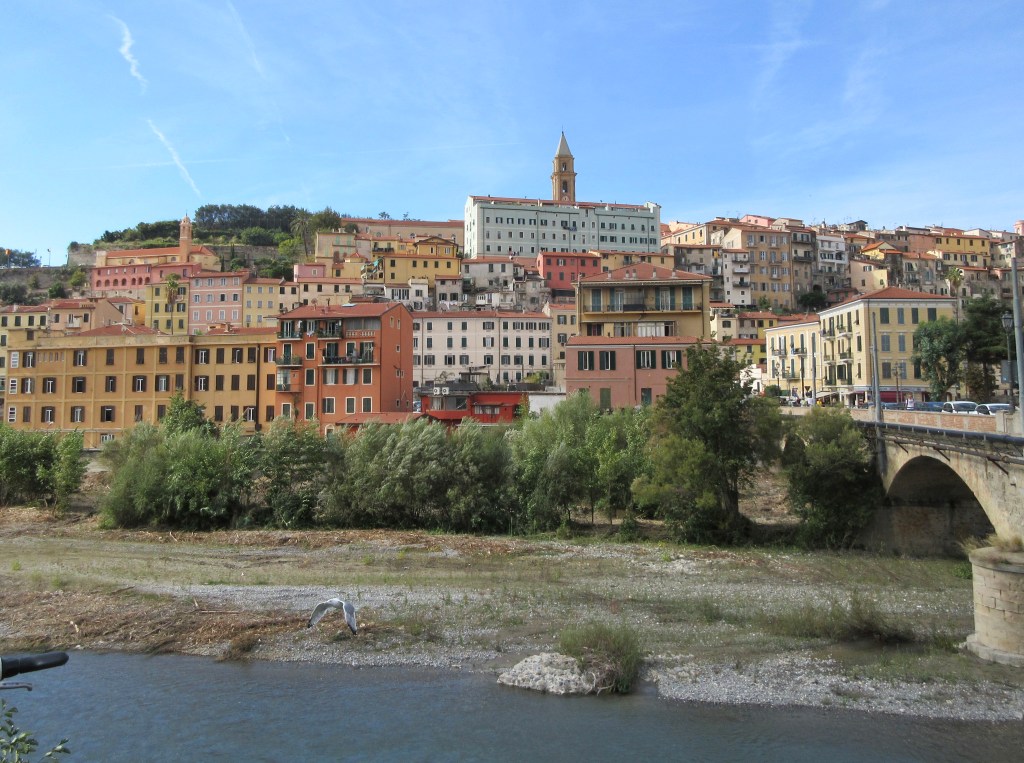
I’ve always been drawn to small medieval villages or walled-in historic hilltop towns when I travel. Admittedly, I was skeptical when Cathryn suggested Ventimiglia as one of our destinations for our 2024 trip to Italy. She had seen the town years prior during a mother-daughter trip but hadn’t visited the ‘old town’ which lay below the mountain-top resort they stayed at.

Looking for our 3rd base of operations after Lake Garda and Venice, I found us an apartment smack in the middle of the historic medieval town of Ventimiglia. With train foul-ups it was a full day ride to the last stop on our Italian adventure. We purposely worked our way south from mid-September in search of decent Autumn weather and a perch overlooking the Mediterranean Sea.

Although dusk was upon us on arrival, we were immediately in awe when the taxi dropped us in the piazza in front of a beautiful 800 year old stone church. Our apartment was only two doors away and although the stairs up to it were brutal with luggage in tow, we were blown away by the view. We had two balconies overlooking the main pedestrian street and a rooftop terrace offering a panorama of the church belltower and azure blue sea.

Too hungry from our long journey to bother unpacking, we headed back down the stairs and quickly surveyed our new neighborhood for somewhere to eat. There was a wine bar across the street and a cafe directly below our apartment but neither offered a full meal. We took a chance on a little restaurant right next to the church. Serving unique traditional dishes, it turned out to be our favorite place in town.

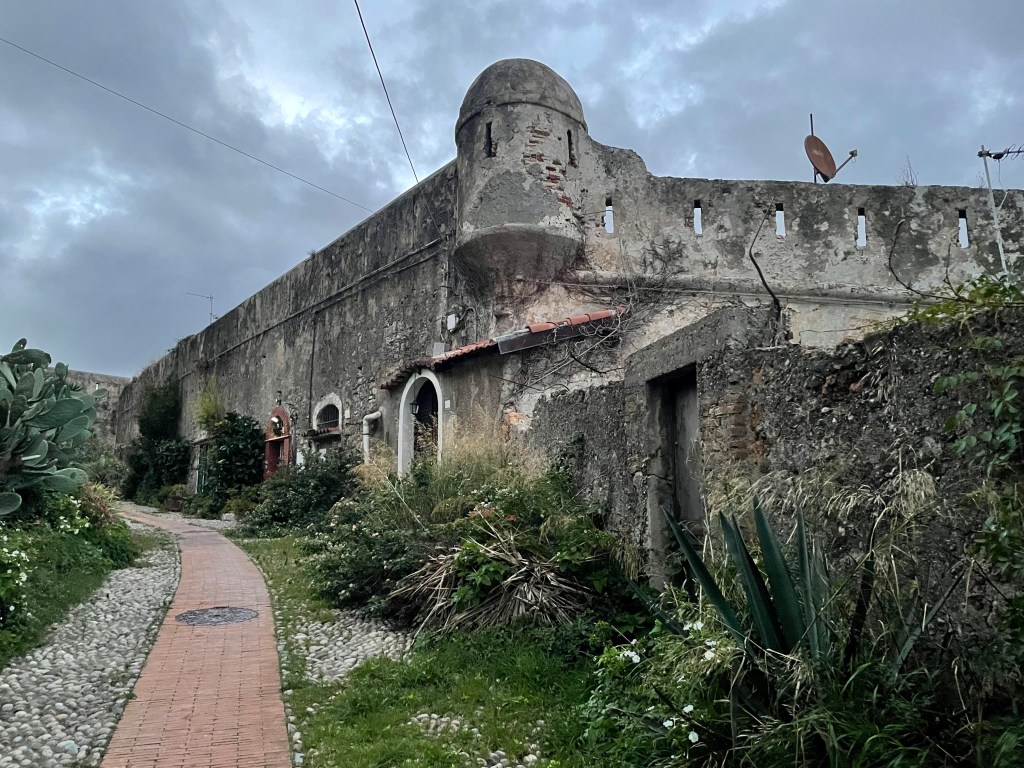
The streetlights were on when we left the restaurant, showcasing the quaint little medieval town that would be our home for the next twelve days. Ventimiglia has a population of 20k souls but I’d guess the old town has about 2k at most. The residents live mostly in 3 and 4 story buildings ranging in age from 200 to 600 years old, built right into the rock with winding and narrow streets or alleys, some barely wide enough to walk two abreast.

The main road up the mountain and into town stops at our doorstep, with no vehicular traffic allowed beyond that. Even Amazon has to deliver on foot. Cathryn and I has a blast exploring the old town, choosing tunnels and narrow passageways just to see where they led. The town’s ancient walls are still intact, with arched gates on three sides allowing entry. Some homes are actually built right into the wall.

Our balconies allowed us to observe everyday life in the medieval village. Like everywhere else in the world, many adults were on their cellphones. But children actually played – soccer or tag in the street or church piazza, some yelling back and forth – I think just to hear their own voices echoing off the stone buildings. There is no grass anywhere in town, but succulents do well in this climate and many homes have potted plants on their stoops or window sills.

It’s mostly men who gather at the cafe and in the street, drinking cappuccino or beer depending on time of day. Women’s presence is known by the aroma of baked goods or prepared meals wafting out of neighborhood windows. We only had to poke our noses out the balcony door to know it was dinner time. And we’ve had some awesome food, sticking to mostly traditional dishes to fully appreciate the local culture.

Cathryn and I don’t do cappuccino and croissants for breakfast every day but I’d be lying if I said we didn’t try it. With a local market only a few doors down, we ate at least half our meals in. To my dismay, bacon and eggs or even omelettes are not a breakfast staple in Italy. But fresh bread, pizza, pasta and seafood is. We had some amazing pasta dishes, even more amazing squid and octopus in warm and cold dishes. And it ain’t Windsor pizza but still very good.

Ventimiglia is only 20 minutes from the French border so it makes a good base to explore from. Nice and Monaco are within an hour by train. There are also other great Italian cities and towns close by to visit. We used an Italian rail pass but if you want to venture into France go for the 2 country or global Eurail pass. The area is easily accessible by car with easier access to small towns since bus service can be limited.

Venice – Most Unique City in the World

I will do my best to describe the City of Venice and what’s it’s like, but I believe it is one place in the world you should experience yourself to truly understand and enjoy just how unique it really is. Cathryn and I have both been there before but we loved it enough to visit once again for her 60th birthday year. Our plan for this trip was to skip the heavily trafficked touristy sites and take in the outer islands of Torcino, Burano and Murano.

If we stay more than one night in any location I try to book something with a kitchen, such as an Airbnb or something on VRBO so my personal chef can prepare some of our meals in. This worked well for us since breakfasts in Italy consist of pastries and coffee, one of which is bad for my waistline and the other something I’ve never consumed. Lunches were usually some type of ham sandwich while we were out exploring.

Although my chef prepared some awesome pasta dinners in, we ate many of our dinners out. Pasta and pizza are available everywhere and usually the cheaper way to go. Seafood dinners were also easy to find but many were pricey for us since 1 Euro is equal to about $1.40 Canadian. Thankfully, food tax is virtually non-existent and tipping is not customary in Italy. But many restaurants charge a 2-3 Euro service fee to make up the difference.

Venice. Some call it the floating city but it’s actually built on reclaimed land in a lagoon, on thousands and thousands of wood pilings. It explains the lack of trees. Experts blamed those same foundations as the reason for Venice’s sinking but it’s now been discovered they’ve drained underground aquifers for centuries to get drinking water, causing the city to sink. Higher sea levels and advancing tides also invade the city, meaning Venice’s life expectancy is limited.

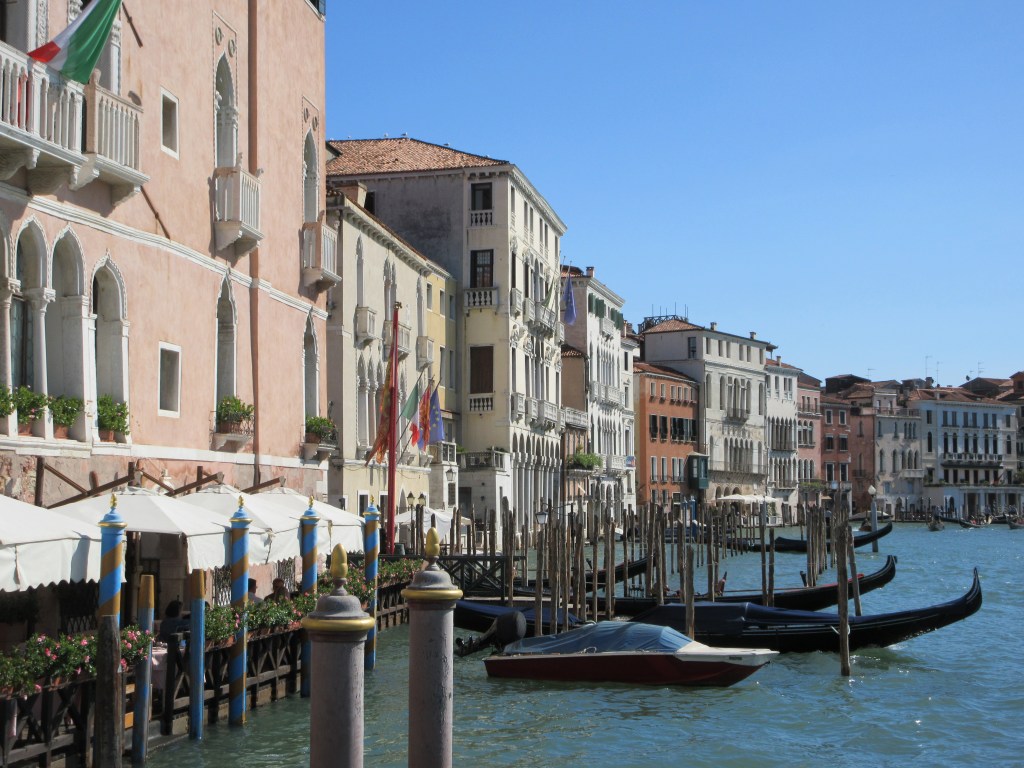
Venice. You won’t experience such a unique city anywhere else in the world. Once a place where people in the 5th century fled to avoid Barbarian conquerors, it later became a major trading hub for fish and salt and by the 9th century it had become a major maritime empire. Arriving in Venice by the Grand Canal, which snakes it’s way through the center of the city, you can still witness the magnificent palaces and buildings showcasing Venetian prosperity.

Nowadays, Venice makes it’s money from mass tourism. It’s gotten so bad that the city had forbidden large cruise ships and they charge a visitation/tourist tax. But it’s still a really cool place to visit, especially if you like history, ancient Byzantine and Baroque architecture, palaces, churches, canals, and Italian food.

Try to imagine a place where there are no front lawns, only water. No cars or trucks. You get everywhere by foot or boat. Even mass transportation is by waterbus, called vaporettos. Those with deep pockets can hire beautifully varnished watercraft, and some locals own their own boats to get around. Everything in Venice moves by water and the canals – people, food, and garbage.

The city is known for it’s gondolas, a hand-crafted canoe of sorts that has become a must-do thing for visiting tourists. The boats costs thousands of dollars to build and gondoliers go through a 4 year training course to master their trade. Some serenade their fares while rowing and weaving their way through various canals. Our apartment overlooked one canal and we watched wide-eyed tourists and even wedding parties go by. It was way better than the cars and trucks that roared by daily at our last place.

Our plan to visit the outer islands made for a perfect visit. We took the vaporetto to Torcello first, a little over an hour away but well worth the trip. Leaving at a popular time of day, our boat was quite packed until the last leg. The island is where it all began, where the Venetians started to build in the lagoon. The cathedral was built in the 7th century and is one of the oldest churches is Italy. Exploring the island left me puzzled, trying to figure out how 20,000 people once lived there. Now there are only 12.

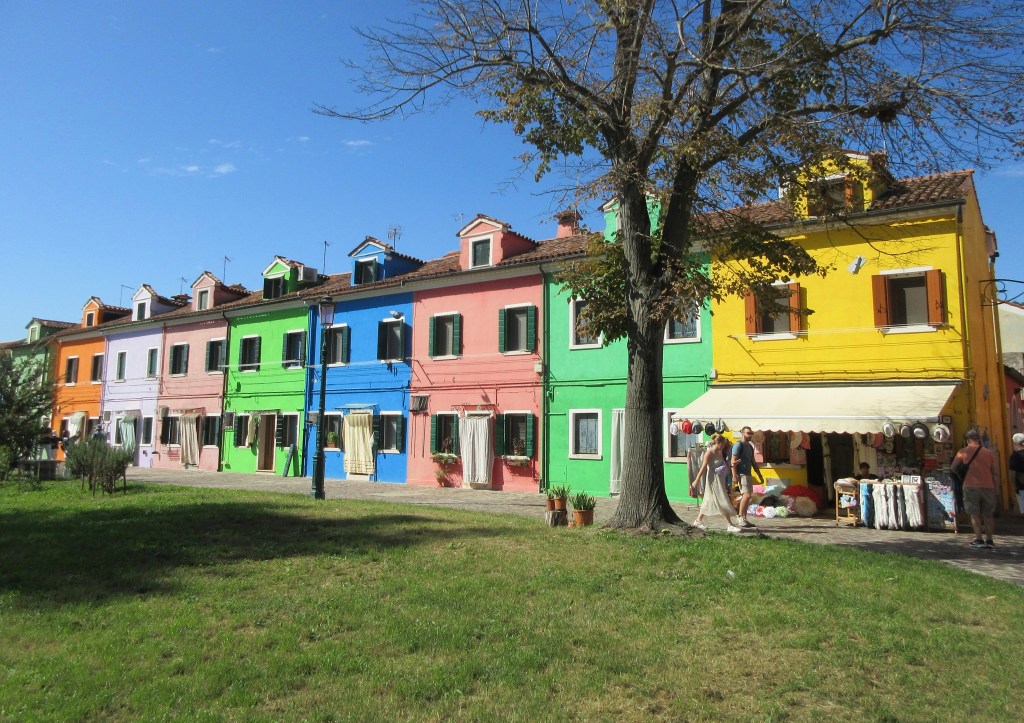
Burano was our next island stop and it completely blew us away. It is easily the most colourful place we’ve ever visited – houses, shops and buildings are all stuccoed or painted in various pastel colours, making neighborhoods look like rows of saltwater taffy. Like the main Venice island, Burano also has canals and plenty of pedestrian only streets to explore. For Cathryn and I, it is our favorite Venetian island.

We visited the island of Murano too but were hard-pressed to be wowed after seeing Burano. But if you’re into hand-crafted Venetian glassware, Murano is the place to go. There are several glass blowing factories to visit and hundreds of stores selling everything from fancy chandeliers to miniature glass ballerinas. The glassware is impressive but the canals and buildings are similar in size and construction to those scattered across the City of Venice.

I conclusion, having been to Venice myself on two previous occasions I wasn’t too excited to see it again. But just as it was on my very first visit, the city grows on you. The heavily-trafficked touristy sites are definitely worth seeing for the first time. But the back streets (like the Jewish Ghetto) take you back in time, where neighbours gathered in piazzas or courtyards. Children without electronic devices, boys playing football and girls skipping rope. Men gathered to drink coffee or beer and women working in the kitchen sending wonderful aromas out the window to passerby.

Garda – Italy’s Largest Lake

Italy is a large country with several beautiful regions to explore. Cathryn and I have been mostly exploring the northern regions and more specifically on the first part of this trip, Lake Garda. It’s the largest of Italy’s lakes, situated in the north and fed by some of the meltwater from the Swiss and Italian Alps. We’d covered much of Lake Como on our last Italian visit but this time we planned to explore Garda and it’s surrounding medieval towns.

We chose the town of Garda as a base, situated on the eastern shore of the lower half of the lake, with plenty of other towns close enough to explore with simple day trips by ferry or bus. Garda Town was the perfect size for us, easily walkable and fun to explore with cobbled pedestrian-only streets, some of which linked piazzas with tunnels under ancient buildings.

Garda has plenty of restaurants serving all sorts of foods, mostly specializing in seafood, pasta and pizza. Funny, no matter what kind of a menu they offer, every single eatery serves pizza. That includes focaccia and bruschetta-sized pizza so budget-minded travellers can afford reasonably priced meals. Most costs were similarly priced to home, more compatible to the American dollar since it is almost at par with the Euro.

Cathyn tells me that prices for clothes and genuine Italian leather goods are way more reasonable than in major tourist centers like Rome or Naples or the Amalfi coast. Ferry tickets between towns on the lake got pricey for longer distances, like the Town of Limone which is at the top of the lake and two hours away. The train stops at Peschiera, on the bottom of the lake so you have to rely on lake ferries or local buses. Taxis and even Uber are very expensive.

There are plenty of walking or hiking paths in the area, with some other towns easily reached on foot. We walked along the lake to Bardolino and then to the cool little town of San Vigilio, where we witnessed a Calvin Klein photoshoot. Both were easy lakeside walks, reachable in about 45 minutes. We also took the ferry to Lazise, Torri del Benaco and Sirmione, all within an hour or so boat ride. Because of heavy road traffic around the lake, the ferries are much more punctual than buses.

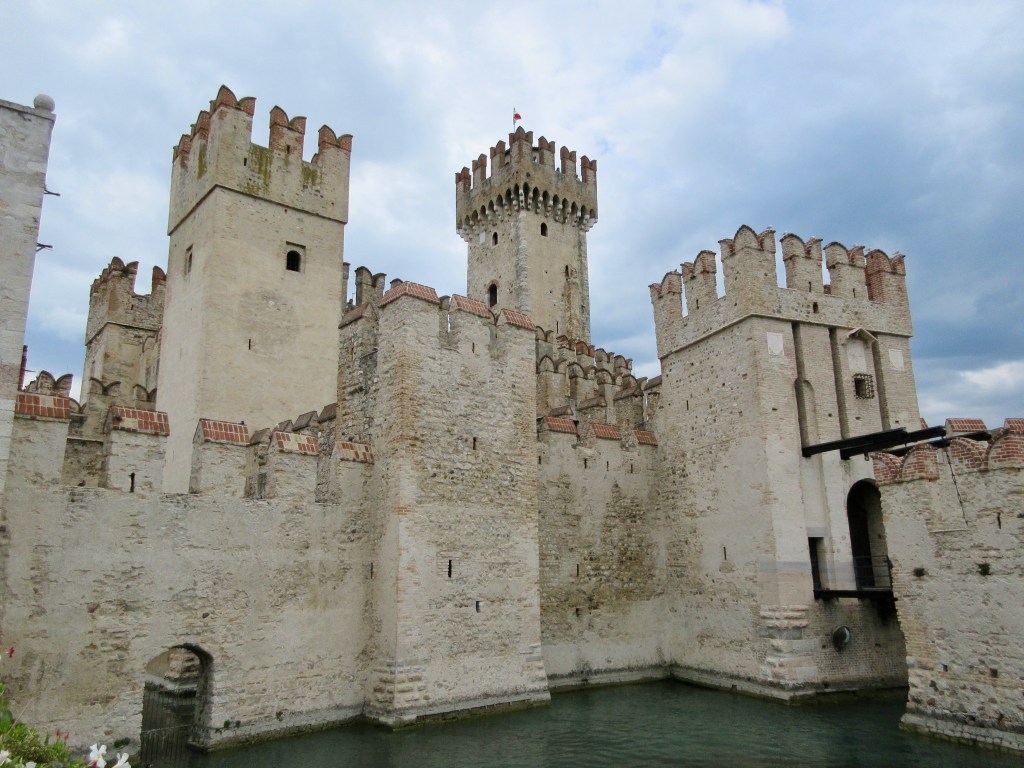
One might think that all medieval towns are the same – you’ve seen one castle town – you’ve seen them all, but we found it wasn’t so. Each town was unique in it’s own way, some walled in by an old fortress and some showcasing their castle as a historic old town centerpiece. Crowds were heavier than we expected for the so-called shoulder season, with getting around much easier early or late in the day. I can’t even imagine how crazy it would be here in summer.

People all over the world visit Italy and Lake Garda, but we found this is the time of year when 80% of tourists are German. And oddly enough, those we encountered were the they most arrogant and rude people we’ve ever met. More so than any Germans we know or have met in Germany. They blatantly cut queues for the ferry or bus, sometimes shoving their way through, and they thought nothing of smoking at a table 10 inches away while eating meals. Never did they offer an excuse me or hello or even a smile.

We had a mixed bag of weather, with a few more clouds and rain that normal, but we managed and only had to don a raincoat or umbrella a couple times. It was sporadic – we had a picture perfect day in Torri del Benaco, while friends we met got rained on all day in another town only 10 miles away. Temperatures were comfortable, depending on sun or cloud, anywhere between 15 to 25 degrees day or night.

If you like lakeside retreats, mountain views, historic small towns with medieval sites all within a couple hours of each other, put Lake Garda on your bucket list. We also visited Verona, only about an hour from Garda Town, but that’s another story.

Bill Bryson – Neither Here Nor There

here nor thereNeither Here nor There: Travels in Europe

15204490

Edmond Gagnon‘s review

Jan 28, 2019  


I’ve known about Bill Bryson for some time and saw a movie about his last travel adventure, but had never got around to reading any of his material. I had ‘Neither Here Nor There’ collecting dust at home with my two shelves of other books to read, and since I was about to leave on a travel adventure myself, I took Bill’s book along to pass the down time when not engaged in sightseeing, eating or drinking.
Having traveled solo like Bryson did in this book, I can truly appreciate his adventures and misadventures in an era before the internet, cell phones, and GPS. Like him, I still love unfolding a map to plan the next day’s route. Bryson is the type of person who is comfortable in his own skin and has no qualms about travelling alone.
He is a good writer, with a sarcastic sense of humor, and an unquenchable thirst for metaphors. The book is more of a collection of snippets from the various cities and towns along his route. He likes to pound the pavement and sit in local watering holes or cafes to get a good feel of each and every place his visits.
Being the author of my own travel book, with some similarities, I generally liked the read, but found it a bit awkward at times – especially when the author went off on one of his rants. His American arrogance toward the rest of the world showed through on more than one occasion. I’m not saying that Mr. Bryson is predjudice against all foreigners, from what I’ve experienced in my travels it’s just the way some Americans are. They love to travel, but expect everything, like food, to be the same as home.