

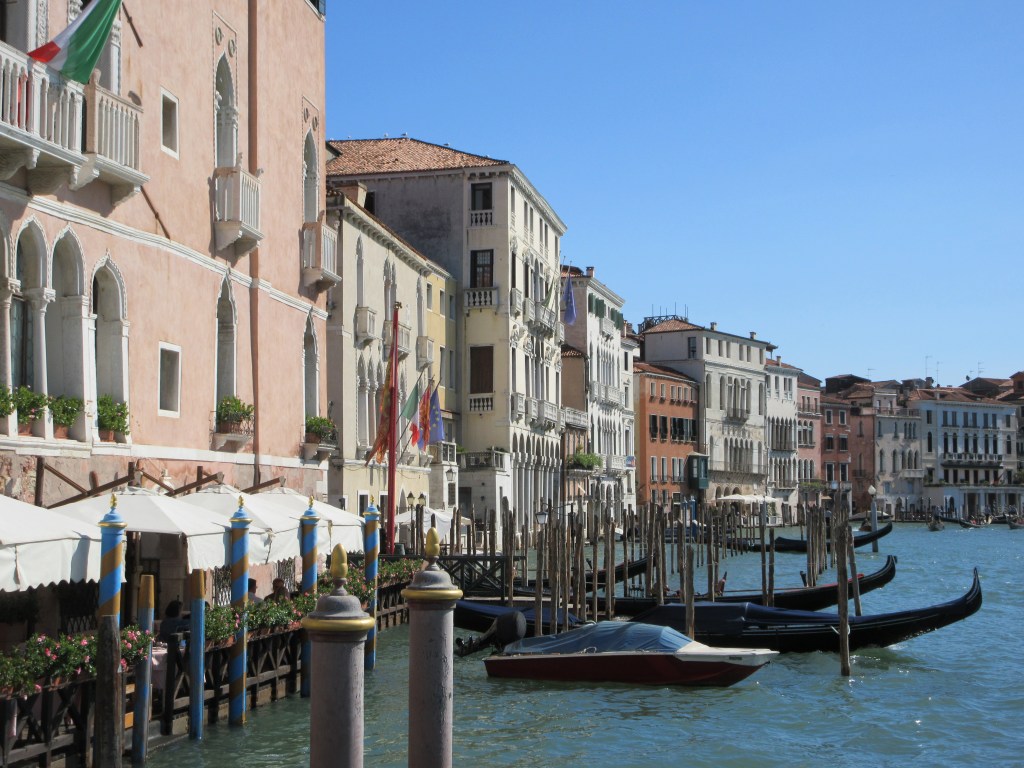
I will do my best to describe the City of Venice and what’s it’s like, but I believe it is one place in the world you should experience yourself to truly understand and enjoy just how unique it really is. Cathryn and I have both been there before but we loved it enough to visit once again for her 60th birthday year. Our plan for this trip was to skip the heavily trafficked touristy sites and take in the outer islands of Torcino, Burano and Murano.
If we stay more than one night in any location I try to book something with a kitchen, such as an Airbnb or something on VRBO so my personal chef can prepare some of our meals in. This worked well for us since breakfasts in Italy consist of pastries and coffee, one of which is bad for my waistline and the other something I’ve never consumed. Lunches were usually some type of ham sandwich while we were out exploring.

Although my chef prepared some awesome pasta dinners in, we ate many of our dinners out. Pasta and pizza are available everywhere and usually the cheaper way to go. Seafood dinners were also easy to find but many were pricey for us since 1 Euro is equal to about $1.40 Canadian. Thankfully, food tax is virtually non-existent and tipping is not customary in Italy. But many restaurants charge a 2-3 Euro service fee to make up the difference.
Venice. Some call it the floating city but it’s actually built on reclaimed land in a lagoon, on thousands and thousands of wood pilings. It explains the lack of trees. Experts blamed those same foundations as the reason for Venice’s sinking but it’s now been discovered they’ve drained underground aquifers for centuries to get drinking water, causing the city to sink. Higher sea levels and advancing tides also invade the city, meaning Venice’s life expectancy is limited.

Venice. You won’t experience such a unique city anywhere else in the world. Once a place where people in the 5th century fled to avoid Barbarian conquerors, it later became a major trading hub for fish and salt and by the 9th century it had become a major maritime empire. Arriving in Venice by the Grand Canal, which snakes it’s way through the center of the city, you can still witness the magnificent palaces and buildings showcasing Venetian prosperity.
Nowadays, Venice makes it’s money from mass tourism. It’s gotten so bad that the city had forbidden large cruise ships and they charge a visitation/tourist tax. But it’s still a really cool place to visit, especially if you like history, ancient Byzantine and Baroque architecture, palaces, churches, canals, and Italian food.
Try to imagine a place where there are no front lawns, only water. No cars or trucks. You get everywhere by foot or boat. Even mass transportation is by waterbus, called vaporettos. Those with deep pockets can hire beautifully varnished watercraft, and some locals own their own boats to get around. Everything in Venice moves by water and the canals – people, food, and garbage.

The city is known for it’s gondolas, a hand-crafted canoe of sorts that has become a must-do thing for visiting tourists. The boats costs thousands of dollars to build and gondoliers go through a 4 year training course to master their trade. Some serenade their fares while rowing and weaving their way through various canals. Our apartment overlooked one canal and we watched wide-eyed tourists and even wedding parties go by. It was way better than the cars and trucks that roared by daily at our last place.
Our plan to visit the outer islands made for a perfect visit. We took the vaporetto to Torcello first, a little over an hour away but well worth the trip. Leaving at a popular time of day, our boat was quite packed until the last leg. The island is where it all began, where the Venetians started to build in the lagoon. The cathedral was built in the 7th century and is one of the oldest churches is Italy. Exploring the island left me puzzled, trying to figure out how 20,000 people once lived there. Now there are only 12.
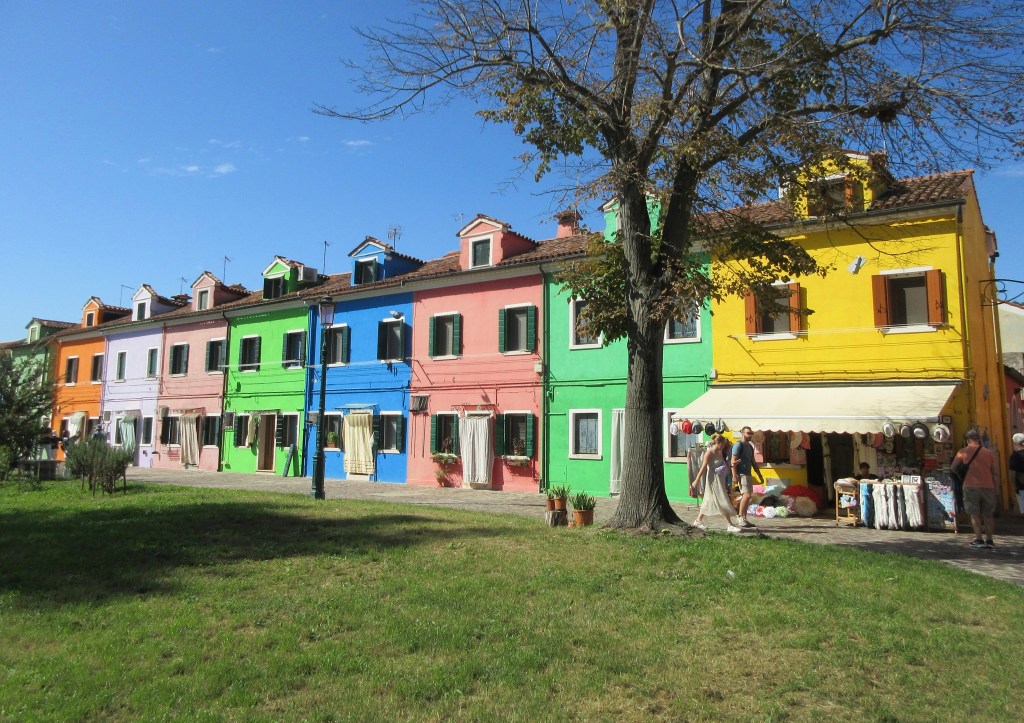
Burano was our next island stop and it completely blew us away. It is easily the most colourful place we’ve ever visited – houses, shops and buildings are all stuccoed or painted in various pastel colours, making neighborhoods look like rows of saltwater taffy. Like the main Venice island, Burano also has canals and plenty of pedestrian only streets to explore. For Cathryn and I, it is our favorite Venetian island.
We visited the island of Murano too but were hard-pressed to be wowed after seeing Burano. But if you’re into hand-crafted Venetian glassware, Murano is the place to go. There are several glass blowing factories to visit and hundreds of stores selling everything from fancy chandeliers to miniature glass ballerinas. The glassware is impressive but the canals and buildings are similar in size and construction to those scattered across the City of Venice.
I conclusion, having been to Venice myself on two previous occasions I wasn’t too excited to see it again. But just as it was on my very first visit, the city grows on you. The heavily-trafficked touristy sites are definitely worth seeing for the first time. But the back streets (like the Jewish Ghetto) take you back in time, where neighbours gathered in piazzas or courtyards. Children without electronic devices, boys playing football and girls skipping rope. Men gathered to drink coffee or beer and women working in the kitchen sending wonderful aromas out the window to passerby.


 Life Written and Reviewed